Ch. 8 - Techniques of Integration
Hass - Thomas' Calculus 15th Edition
Hass15th EditionThomas' CalculusISBN: 9780137616077Not the one you use?Change textbook
Chapter 8, Problem 8.8.83

Exercises 83–86 are about the infinite region in the first quadrant between the curve y = e^(-x) and the x-axis.
83. Find the area of the region.

Verified step by step guidance
1
Identify the region whose area you want to find. Here, it is the area in the first quadrant bounded by the curve \(y = e^{-x}\) and the x-axis.
Set up the definite integral to find the area. Since the region is in the first quadrant and bounded by the x-axis, the limits of integration for \(x\) are from 0 to \(\infty\). The area \(A\) can be expressed as \(A = \int_0^{\infty} e^{-x} \, dx\).
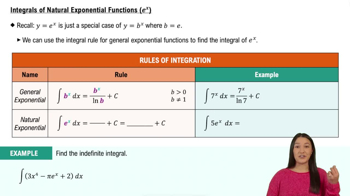
Recall the integral formula for the exponential function: \(\int e^{ax} \, dx = \frac{1}{a} e^{ax} + C\) for \(a \neq 0\). In this case, \(a = -1\).
Evaluate the improper integral by taking the limit as the upper bound approaches infinity: \(A = \lim_{t \to \infty} \int_0^t e^{-x} \, dx\).
Compute the definite integral using the antiderivative and then apply the limit to find the area.

Verified video answer for a similar problem:

This video solution was recommended by our tutors as helpful for the problem above.
Video duration:
8m
Was this helpful?

Key Concepts

Here are the essential concepts you must grasp in order to answer the question correctly.

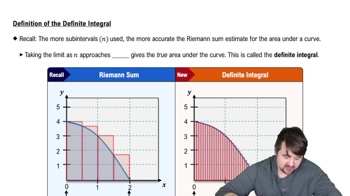
Definite Integral as Area Under a Curve

The definite integral of a function over an interval represents the net area between the curve and the x-axis within that interval. For positive functions, this corresponds to the actual area bounded by the curve, the x-axis, and the vertical limits.
Recommended video:
05:43
Definition of the Definite Integral

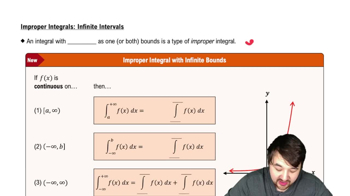
Improper Integrals and Infinite Limits

When the region extends infinitely, such as from a finite point to infinity, the integral is called an improper integral. Evaluating it involves taking a limit as the upper bound approaches infinity to determine if the area converges to a finite value.
Recommended video:
11:11
Improper Integrals: Infinite Intervals

Exponential Decay Function y = e^(-x)

The function y = e^(-x) is an exponential decay curve that approaches zero as x approaches infinity. Its properties ensure that the area under the curve from zero to infinity converges, making it suitable for calculating finite areas over infinite intervals.
Recommended video:
03:39
Integrals of Natural Exponential Functions (e^x)