Ch. 8 - Techniques of Integration
Hass - Thomas' Calculus 15th Edition
Hass15th EditionThomas' CalculusISBN: 9780137616077Not the one you use?Change textbook
Chapter 8, Problem 8.PE.59

Evaluate the improper integrals in Exercises 53–62.
∫ from 0 to ∞ of (x² * e^(−x)) dx

Verified step by step guidance
1
Recognize that the integral \( \int_0^{\infty} x^2 e^{-x} \, dx \) is an improper integral because the upper limit is infinity. This means we need to evaluate it as a limit: \( \lim_{t \to \infty} \int_0^t x^2 e^{-x} \, dx \).
Set up the integral with the limit: \( \lim_{t \to \infty} \int_0^t x^2 e^{-x} \, dx \). We will first find the antiderivative of \( x^2 e^{-x} \) and then apply the limits.
Use integration by parts to find the antiderivative. Let \( u = x^2 \) and \( dv = e^{-x} dx \). Then, compute \( du = 2x dx \) and \( v = -e^{-x} \). Apply the integration by parts formula: \( \int u \, dv = uv - \int v \, du \).
After the first integration by parts, you will get an integral involving \( x e^{-x} \). Apply integration by parts again on this new integral, letting \( u = x \) and \( dv = e^{-x} dx \), and repeat the process to fully evaluate the integral.
Once you have the antiderivative, evaluate it at the limits 0 and \( t \), then take the limit as \( t \to \infty \). This will give you the value of the improper integral.

Verified video answer for a similar problem:

This video solution was recommended by our tutors as helpful for the problem above.
Video duration:
5m
Was this helpful?

Key Concepts

Here are the essential concepts you must grasp in order to answer the question correctly.

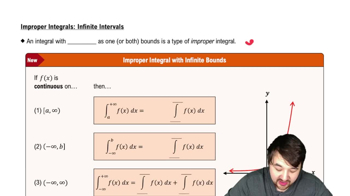
Improper Integrals

Improper integrals involve integration over an infinite interval or integrands with infinite discontinuities. To evaluate them, the integral is expressed as a limit where the bound approaches infinity or the point of discontinuity. Convergence or divergence is determined by the existence of this limit.
Recommended video:
11:11
Improper Integrals: Infinite Intervals

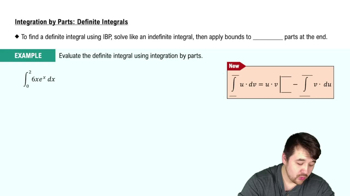
Integration by Parts

Integration by parts is a technique based on the product rule for differentiation, used to integrate products of functions. It transforms the integral of u dv into uv minus the integral of v du, simplifying complex integrals like x² e^(−x). Choosing u and dv wisely is key to success.
Recommended video:
06:18
Integration by Parts for Definite Integrals

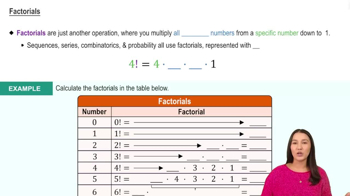
Gamma Function and Factorials

The Gamma function generalizes factorials to non-integer values and is defined as an improper integral involving x^(n) e^(−x). Recognizing integrals of the form ∫₀^∞ x^n e^(−x) dx as Gamma functions helps evaluate them quickly, where Γ(n+1) = n! for positive integers n.
Recommended video:
5:22
Factorials