
Ch. 8 - Techniques of Integration
Hass - Thomas' Calculus 15th Edition
Hass15th EditionThomas' CalculusISBN: 9780137616077Not the one you use?Change textbook
Chapter 8, Problem 8.PE.135

135. Evaluate ∫₀^(π/2) (sin x) / (sin x + cos x) dx in two ways:
(a) By evaluating ∫ (sin x) / (sin x + cos x) dx, then using the Evaluation Theorem.

Verified step by step guidance
1
Start by defining the integral: \(I = \int_0^{\frac{\pi}{2}} \frac{\sin x}{\sin x + \cos x} \, dx\).
To evaluate the integral directly, consider the integrand \(f(x) = \frac{\sin x}{\sin x + \cos x}\). Find its antiderivative \(F(x)\) by using algebraic manipulation or substitution techniques.
One useful approach is to rewrite the integrand as \(\frac{\sin x}{\sin x + \cos x} = 1 - \frac{\cos x}{\sin x + \cos x}\), which might simplify the integration process.
Integrate each term separately: \(\int 1 \, dx\) and \(\int \frac{\cos x}{\sin x + \cos x} \, dx\). For the second integral, consider the substitution \(u = \sin x + \cos x\), then find \(du\) and express the integral in terms of \(u\).
After finding the antiderivative \(F(x)\), apply the Evaluation Theorem (Fundamental Theorem of Calculus) by computing \(F\left(\frac{\pi}{2}\right) - F(0)\) to get the value of the definite integral.

Verified video answer for a similar problem:

This video solution was recommended by our tutors as helpful for the problem above.
Video duration:
6m
Was this helpful?

Key Concepts

Here are the essential concepts you must grasp in order to answer the question correctly.

Definite Integral and Evaluation Theorem

A definite integral calculates the net area under a curve between two limits. The Evaluation Theorem states that if F is an antiderivative of f, then ∫_a^b f(x) dx = F(b) - F(a). This allows us to find the exact value of the integral by evaluating the antiderivative at the boundaries.
Recommended video:
05:43
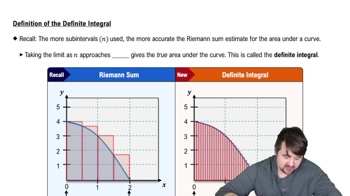
Definition of the Definite Integral

Integration Techniques for Rational Trigonometric Functions

Integrating expressions like (sin x) / (sin x + cos x) often requires algebraic manipulation or substitution to simplify the integrand. Recognizing patterns or using substitutions such as t = tan x or rewriting numerator and denominator can make the integral more manageable.
Recommended video:
6:04
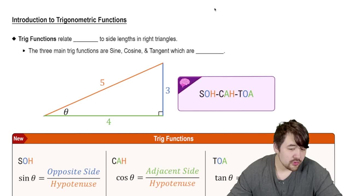
Introduction to Trigonometric Functions

Symmetry and Complementary Angle Properties in Definite Integrals

For integrals over [0, π/2], using symmetry or the property f(π/2 - x) can simplify evaluation. This approach exploits complementary angles in sine and cosine to relate integrals and sometimes find values without direct integration.
Recommended video:
05:43
Definition of the Definite Integral