Ch. 8 - Techniques of Integration
Hass - Thomas' Calculus 15th Edition
Hass15th EditionThomas' CalculusISBN: 9780137616077Not the one you use?Change textbook
Chapter 8, Problem 8.3.74

Area: Find the area between the x-axis and the curve y = √(1 + cos 4x), for 0 ≤ x ≤ π.

Verified step by step guidance
1
Identify the function and the interval: We want to find the area between the x-axis and the curve given by \(y = \sqrt{1 + \cos 4x}\) over the interval \(0 \leq x \leq \pi\).
Set up the definite integral for the area: Since the function is non-negative over the interval, the area can be expressed as \(\int_0^{\pi} \sqrt{1 + \cos 4x} \, dx\).
Use a trigonometric identity to simplify the integrand: Recall that \(\cos 4x = 2\cos^2 2x - 1\), so \(1 + \cos 4x = 2\cos^2 2x\). Substitute this into the integral to rewrite the integrand as \(\sqrt{2\cos^2 2x}\).
Simplify the square root expression: Since \(\sqrt{2\cos^2 2x} = \sqrt{2} |\cos 2x|\), rewrite the integral as \(\int_0^{\pi} \sqrt{2} |\cos 2x| \, dx\).
Handle the absolute value by determining where \(\cos 2x\) is positive or negative on \([0, \pi]\): Split the integral at points where \(\cos 2x = 0\), then integrate \(\sqrt{2} \cos 2x\) where it is positive and \(-\sqrt{2} \cos 2x\) where it is negative, summing the results to find the total area.

Verified video answer for a similar problem:

This video solution was recommended by our tutors as helpful for the problem above.
Video duration:
3m
Was this helpful?

Key Concepts

Here are the essential concepts you must grasp in order to answer the question correctly.

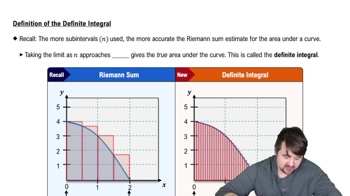
Definite Integral for Area Calculation

The area between a curve and the x-axis over an interval [a, b] is found using the definite integral of the function from a to b. This integral sums the infinitesimal vertical slices under the curve, providing the total area.
Recommended video:
05:43
Definition of the Definite Integral

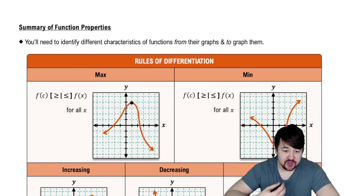
Properties of Trigonometric Functions

Understanding the behavior of trigonometric functions like cosine, especially with multiples of the variable (e.g., cos 4x), is essential. This helps in analyzing the function's periodicity, symmetry, and positivity within the given interval.
Recommended video:
06:21
Properties of Functions

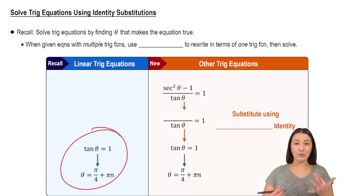
Simplification Using Trigonometric Identities

Applying trigonometric identities, such as the double-angle or power-reduction formulas, can simplify the integrand √(1 + cos 4x). Simplification often makes the integral more manageable or expressible in terms of standard integrals.
Recommended video:
4:42
Solve Trig Equations Using Identity Substitutions