Back
Back
Problem 7.3.83
In Exercises 59–86, find the derivative of y with respect to the given independent variable.
83. y = 3^(log₂ t)
Problem 7.1.38
Show that the graph of the inverse of f(x)=mx+b, where m and b are constants and m≠0, is a line with slope 1/m and y-intercept -b/m.
Problem 7.3.79
In Exercises 59–86, find the derivative of y with respect to the given independent variable.
79. y = θ sin(log₇ θ)
Problem 7.1.1
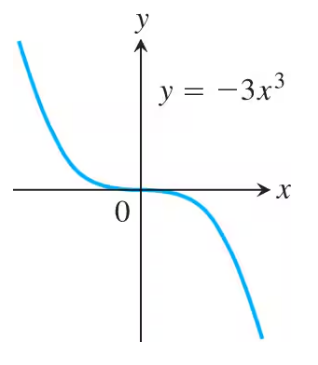
Which of the functions graphed in Exercises 1–6 are one-to-one, and which are not?
Problem 7.6.31
In Exercises 21–48, find the derivative of y with respect to the appropriate variable.
31. y=arccot(√t)
Problem 7.5.32
Use l’Hôpital’s rule to find the limits in Exercises 7–52.
32. lim (x → 0) (3^x - 1) / (2^x - 1)
Problem 7.1.35
Each of Exercises 25–36 gives a formula for a function y=f(x). In each case, find f^(-1)(x) and identify the domain and range of f^(-1). As a check, show that f(f^(-1)(x))=f^(-1)(f(x))=x.
f(x) = (x + b) / (x − 2), b > −2 and constant
Problem 7.1.19
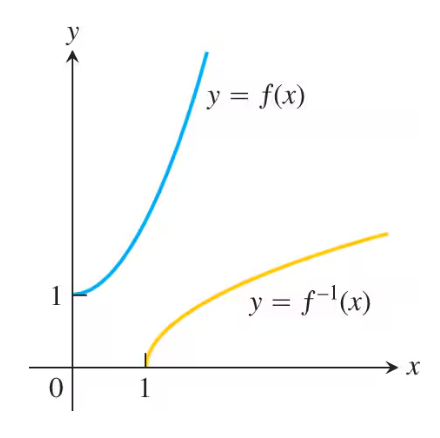
Each of Exercises 19–24 gives a formula for a function y=f(x) and shows the graphs of f and f^(-1). Find a formula for f^(-1) in each case.
f(x)=x²+1, x≥0
Problem 7.2.41
Evaluate the integrals in Exercises 39–56.
41. ∫2y dy/(y²-25)
Problem 7.3.112
Evaluate the integrals in Exercises 111–114.
112. ∫₁^(eˣ) (1 / t) dt
Problem 7.3.21
In Exercises 7–26, find the derivative of y with respect to x, t, or θ, as appropriate.
y = ln(e^(θ)/(1+e^θ))
Problem 7.3.35
Evaluate the integrals in Exercises 33–54.
∫(from ln3 to ln2) (e^x) dx
Problem 7.3.31
In Exercises 27–32, find dy/dx.
3+siny = y-x^3
Problem 7.5.69
Theory and Applications
L’Hôpital’s Rule does not help with the limits in Exercises 69–76.
Try it—you just keep on cycling. Find the limits some other way.
69. lim (x → ∞) (√(9x + 1)) / (√(x + 1))
Problem 7.3.107
Evaluate the integrals in Exercises 97–110.
107. ∫₀⁹ (2 log₁₀(x + 1) / (x + 1)) dx
Problem 7.7.19
In Exercises 13–24, find the derivative of y with respect to the appropriate variable.
19. y = (sech θ)(1-ln(sech θ))
Problem 7.3.73
In Exercises 59–86, find the derivative of y with respect to the given independent variable.
73. y = log₄ x + log₄ x²
Problem 7.2.45
Evaluate the integrals in Exercises 39–56.
45. ∫(from 1 to 2)(2ln x)/x dx
Problem 7.2.52
Evaluate the integrals in Exercises 39–56.
52. ∫(from π/4 to π/2)cot(t)dt
Problem 7.6.49
For problems 49–52 use implicit differentiation to find dy/dx at the given point P.
49. 3arctan(x) + arcsin(y) = π/4; P(1, -1)
Problem 7.5.71
Theory and Applications
L’Hôpital’s Rule does not help with the limits in Exercises 69–76.
Try it—you just keep on cycling. Find the limits some other way.
71. lim (x → (π/2)⁻) sec x / tan x
Problem 7.7.29
In Exercises 25–36, find the derivative of y with respect to the appropriate variable.
29. y = (1 - t)coth⁻¹(√t)
Problem 7.3.87
Evaluate the integrals in Exercises 87–96.
87. ∫ 5ˣ dx
Problem 7.3.29
In Exercises 27–32, find dy/dx.
e^(2x)=sin(x+3y)
Problem 7.6.105
L’Hôpital’s Rule
Find the limits in Exercises 103–110.
105. lim(x→∞) x arctan(2/x)
Problem 7.6.51
For problems 49–52 use implicit differentiation to find dy/dx at the given point P.
51. y arccos(xy) = -3√2/4 π; P(1/2, -√2)
Problem 7.1.57
Use the results of Exercise 55 to show that the functions in Exercises 56–60 have inverses over their domains. Find a formula for df⁻¹/dx using Theorem 1.
f(x) = 27x³
Problem 7.3.45
Evaluate the integrals in Exercises 33–54.
∫ (e^(1/x) / x²) dx
Problem 7.6.117
Solve the initial value problems in Exercises 115–120.
117. dy/dx = 1/(x√(x² - 1)), x > 1; y(2) = π
Problem 7.4.21
Solve the differential equation in Exercises 9–22.
21. (1/x)(dy/dx) = ye^(x²) + 2√y e^(x²)