Back
Back
Problem 7.3.73
In Exercises 59–86, find the derivative of y with respect to the given independent variable.
73. y = log₄ x + log₄ x²
Problem 7.3.61
In Exercises 59–86, find the derivative of y with respect to the given independent variable.
61. y = 5√s
Problem 7.3.130
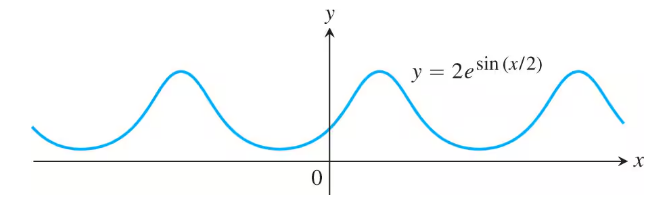
130. Where does the periodic function f(x) = 2e^(sin(x/2)) take on its extreme values, and what are these values?
Problem 7.3.128
For Exercises 127 and 128 find a function f satisfying each equation.
128. f(x) = e² + ∫₁ˣ f(t) dt
Problem 7.6.23
In Exercises 21–48, find the derivative of y with respect to the appropriate variable.
23. y=arcsin(√2t)
Problem 7.3.21
In Exercises 7–26, find the derivative of y with respect to x, t, or θ, as appropriate.
y = ln(e^(θ)/(1+e^θ))
Problem 7.2.35
In Exercises 7–38, find the derivative of y with respect to x, t, or θ, as appropriate.
35. y = ln((x²+1)^5/√(1-x))
Problem 7.6.37
In Exercises 21–48, find the derivative of y with respect to the appropriate variable.
37. y=s√(1-s²) + arccos(s)
Problem 7.6.11
Find the values in Exercises 9–12.
11. tan(arcsin(-1/2))
Problem 7.2.16
In Exercises 7–38, find the derivative of y with respect to x, t, or θ, as appropriate.
16. y = (ln x)³
Problem 7.7.4
Each of Exercises 1–4 gives a value of sinh x or cosh x. Use the definitions and the identity cosh²x - sinh²x = 1 to find the values of the remaining five hyperbolic functions.
4. cosh x = 13/5, x>0
Problem 7.4.12
Solve the differential equation in Exercises 9–22.
12. (dy/dx) = 3x²e^(-y)
Problem 7.7.63
Since the hyperbolic functions can be expressed in terms of exponential functions, it is possible to express the inverse hyperbolic functions in terms of logarithms, as shown in the following table.
sinh⁻¹x = ln(x + √(x² + 1)), -∞ < x < ∞
cosh⁻¹x = ln(x + √(x² - 1)), x ≥ 1
tanh⁻¹x = (1/2)ln((1+x)/(1-x)), |x| < 1
sech⁻¹x = ln((1+√(1-x²))/x), 0 < x ≤ 1
csch⁻¹x = ln(1/x + √(1+x²)/|x|), x ≠ 1
coth⁻¹x = (1/2)ln((x+1)/(x-1)), |x| > 1
Use these formulas to express the numbers in Exercises 61–66 in terms of natural logarithms.
63. tanh⁻¹(-1/2)
Problem 7.1.27
Each of Exercises 25–36 gives a formula for a function y=f(x). In each case, find f^(-1)(x) and identify the domain and range of f^(-1). As a check, show that f(f^(-1)(x))=f^(-1)(f(x))=x.
f(x) = x³ + 1
Problem 7.3.111
Evaluate the integrals in Exercises 111–114.
111. ∫₁^(ln x) (1 / t) dt, x > 1
Problem 7.2.52
Evaluate the integrals in Exercises 39–56.
52. ∫(from π/4 to π/2)cot(t)dt
Problem 7.7.27
In Exercises 25–36, find the derivative of y with respect to the appropriate variable.
27. y = (1 - θ)tanh⁻¹(θ)
Problem 7.3.57
Solve the initial value problems in Exercises 55–58.
57. d²y/dx² = 2e^(−x), y(0) = 1, y′(0) = 0
Problem 7.1.29
Each of Exercises 25–36 gives a formula for a function y=f(x). In each case, find f^(-1)(x) and identify the domain and range of f^(-1). As a check, show that f(f^(-1)(x))=f^(-1)(f(x))=x.
f(x) = 1/x², x > 0
Problem 7.5.30
Use l’Hôpital’s rule to find the limits in Exercises 7–52.
30. lim (θ → 0) ((1/2)^θ - 1) / θ
Problem 7.8.7
7. Order the following functions from slowest growing to fastest growing as x→∞.
a. e^x
b. x^x
c. (ln x)^x
d. e^(x/2)
Problem 7.6.63
Evaluate the integrals in Exercises 53–76.
63. ∫(from -1 to -√2/2)dy/(y√(4y²-1))
Problem 7.6.113
Verify the integration formulas in Exercises 111–114.
113. ∫ (arcsin x)² dx = x(arcsin x)² - 2x + 2 √(1 - x²) arcsin x + C
Problem 7.6.53
Evaluate the integrals in Exercises 53–76.
53. ∫dx/√(9-x²)
Problem 7.6.61
Evaluate the integrals in Exercises 53–76.
61. ∫(from 0 to 2)dt/√(8+2t²)
Problem 7.5.66
Indeterminate Powers and Products
Find the limits in Exercises 53–68.
66. lim (x → 0⁺) x (ln x)²
Problem 7.6.71
Evaluate the integrals in Exercises 53–76.
71. ∫(from -π/2 to π/2) 2cosθ dθ/(1+(sinθ)²)
Problem 7.2.87
Solve the initial value problems in Exercises 87 and 88.
87. dy/dx = 1 + 1/x, y(1) = 3
Problem 7.5.90
90. Find f'(0) for
f(x) = e^(-1/x²), x≠0
= 0, x = 0.
Problem 7.6.130
130. Use the identity arccot(u)=π/2 - arctan(u) to derive the formula for the derivative of arccot(u) in Table 7.4 from the formula for the derivative of arctan(u).