Ch. 7 - Transcendental Functions
Hass - Thomas' Calculus 15th Edition
Hass15th EditionThomas' CalculusISBN: 9780137616077Not the one you use?Change textbook
Chapter 7, Problem 7.6.111

Verify the integration formulas in Exercises 111–114.
111. ∫ (arctan x) / x² dx = ln x - 1/2 ln(1 + x²) - arctan x / x + C

Verified step by step guidance
1
Identify the integral to verify: \(\int \frac{\arctan x}{x^{2}} \, dx\).
Consider using integration by parts. Let \(u = \arctan x\) and \(dv = \frac{1}{x^{2}} dx\).
Compute the derivatives and integrals needed: \(du = \frac{1}{1 + x^{2}} dx\) and \(v = -\frac{1}{x}\).
Apply the integration by parts formula: \(\int u \, dv = uv - \int v \, du\), which gives \(-\frac{\arctan x}{x} - \int \left(-\frac{1}{x} \cdot \frac{1}{1 + x^{2}}\right) dx\).
Simplify the remaining integral \(\int \frac{1}{x(1 + x^{2})} dx\) by using partial fraction decomposition or substitution, then combine all parts to match the given formula.

Verified video answer for a similar problem:

This video solution was recommended by our tutors as helpful for the problem above.
Video duration:
5m
Was this helpful?

Key Concepts

Here are the essential concepts you must grasp in order to answer the question correctly.

Integration by Parts

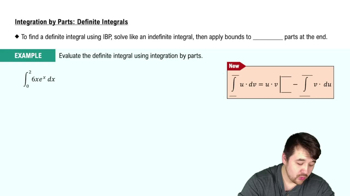
Integration by parts is a technique used to integrate products of functions. It is based on the product rule for differentiation and follows the formula ∫u dv = uv - ∫v du. Choosing appropriate u and dv is crucial to simplify the integral effectively.
Recommended video:
06:18
Integration by Parts for Definite Integrals

Derivative and Integral of Inverse Trigonometric Functions

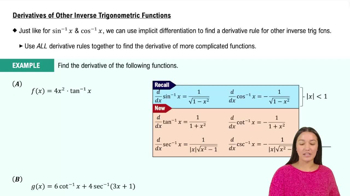
Understanding the derivatives and integrals of inverse trigonometric functions like arctan(x) is essential. For example, d/dx [arctan x] = 1/(1 + x²). This knowledge helps in manipulating integrals involving arctan(x) and recognizing patterns during integration.
Recommended video:
06:35
Derivatives of Other Inverse Trigonometric Functions

Logarithmic Integration and Simplification

Integrals often result in logarithmic expressions, especially when integrating rational functions. Recognizing when to rewrite expressions using logarithm properties, such as ln(a) - ln(b) = ln(a/b), aids in simplifying the final answer and verifying given formulas.
Recommended video:
7:30
Logarithms Introduction