Ch. 7 - Transcendental Functions
Hass - Thomas' Calculus 15th Edition
Hass15th EditionThomas' CalculusISBN: 9780137616077Not the one you use?Change textbook
Chapter 7, Problem 7.1.63

Suppose that the range of g lies in the domain of f so that the composition fog is defined. If f and g are one-to-one, can anything be said about fog? Give reasons for your answer.

Verified step by step guidance
1
Recall the definition of a one-to-one (injective) function: a function \( h \) is one-to-one if \( h(a) = h(b) \) implies \( a = b \).
Given that \( f \) and \( g \) are both one-to-one, consider the composition \( f \circ g \), defined by \( (f \circ g)(x) = f(g(x)) \).
To check if \( f \circ g \) is one-to-one, assume \( (f \circ g)(x_1) = (f \circ g)(x_2) \). This means \( f(g(x_1)) = f(g(x_2)) \).
Since \( f \) is one-to-one, \( f(g(x_1)) = f(g(x_2)) \) implies \( g(x_1) = g(x_2) \).
Because \( g \) is also one-to-one, \( g(x_1) = g(x_2) \) implies \( x_1 = x_2 \). Therefore, \( f \circ g \) is one-to-one.

Verified video answer for a similar problem:

This video solution was recommended by our tutors as helpful for the problem above.
Video duration:
1m
Was this helpful?

Key Concepts

Here are the essential concepts you must grasp in order to answer the question correctly.

Function Composition

Function composition involves applying one function to the result of another, denoted as (f ∘ g)(x) = f(g(x)). For composition to be defined, the range of g must lie within the domain of f. Understanding this ensures the combined function is valid and can be analyzed.
Recommended video:
3:48
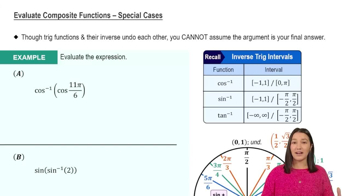
Evaluate Composite Functions - Special Cases

One-to-One (Injective) Functions

A function is one-to-one if it maps distinct inputs to distinct outputs, meaning no two different inputs share the same output. This property is crucial for invertibility and affects how compositions behave, especially regarding uniqueness of outputs.
Recommended video:
05:50
One-Sided Limits

Injectivity of Compositions

The composition of two one-to-one functions is also one-to-one. Since both f and g are injective, their composition f ∘ g preserves distinctness of inputs, ensuring that (f ∘ g)(x1) ≠ (f ∘ g)(x2) whenever x1 ≠ x2, thus making f ∘ g injective.
Recommended video:
3:48
Evaluate Composite Functions - Special Cases