Ch. 7 - Transcendental Functions
Hass - Thomas' Calculus 15th Edition
Hass15th EditionThomas' CalculusISBN: 9780137616077Not the one you use?Change textbook
Chapter 7, Problem 7.5.14

Use l’Hôpital’s rule to find the limits in Exercises 7–52.


14. lim (t → 0) sin 5t / 2t

Verified step by step guidance
1
Identify the limit expression: \(\lim_{t \to 0} \frac{\sin 5t}{2t}\).
Check if the limit is an indeterminate form by substituting \(t = 0\): both numerator \(\sin 5(0) = 0\) and denominator \(2(0) = 0\), so the form is \(\frac{0}{0}\), which allows the use of l'Hôpital's Rule.
Apply l'Hôpital's Rule by differentiating the numerator and denominator separately with respect to \(t\): the derivative of the numerator \(\sin 5t\) is \(5 \cos 5t\), and the derivative of the denominator \$2t$ is \(2\).
Rewrite the limit using these derivatives: \(\lim_{t \to 0} \frac{5 \cos 5t}{2}\).
Evaluate the new limit by substituting \(t = 0\): calculate \(\frac{5 \cos 0}{2}\), noting that \(\cos 0 = 1\).

Verified video answer for a similar problem:

This video solution was recommended by our tutors as helpful for the problem above.
Video duration:
2m
Was this helpful?

Key Concepts

Here are the essential concepts you must grasp in order to answer the question correctly.

Limits and Indeterminate Forms

Limits describe the behavior of a function as the input approaches a particular value. When direct substitution results in an indeterminate form like 0/0, special techniques such as l’Hôpital’s rule are needed to evaluate the limit.
Recommended video:
05:50
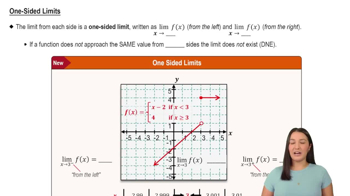
One-Sided Limits

l’Hôpital’s Rule

l’Hôpital’s rule states that if a limit yields an indeterminate form 0/0 or ∞/∞, the limit of the ratio of the functions equals the limit of the ratio of their derivatives, provided this latter limit exists.
Recommended video:

Derivative of Trigonometric Functions

Understanding the derivatives of sine and cosine functions is essential when applying l’Hôpital’s rule to trigonometric limits. For example, the derivative of sin(kt) with respect to t is k cos(kt), which helps simplify the limit expression.
Recommended video:
06:35
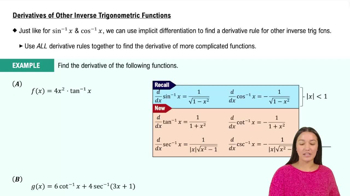
Derivatives of Other Inverse Trigonometric Functions