Ch. 7 - Transcendental Functions
Hass - Thomas' Calculus 15th Edition
Hass15th EditionThomas' CalculusISBN: 9780137616077Not the one you use?Change textbook
Chapter 7, Problem 7.6.105

L’Hôpital’s Rule
Find the limits in Exercises 103–110.
105. lim(x→∞) x arctan(2/x)

Verified step by step guidance
1
Identify the limit expression: \(\lim_{x \to \infty} x \arctan\left(\frac{2}{x}\right)\).
Recognize that as \(x \to \infty\), the argument \(\frac{2}{x} \to 0\), so \(\arctan\left(\frac{2}{x}\right) \to \arctan(0) = 0\). This creates an indeterminate form of type \(\infty \cdot 0\).
Rewrite the expression to apply L'Hôpital's Rule by converting the product into a quotient: write \(x \arctan\left(\frac{2}{x}\right)\) as \(\frac{\arctan\left(\frac{2}{x}\right)}{\frac{1}{x}}\).
Check the new limit form as \(x \to \infty\): numerator \(\arctan\left(\frac{2}{x}\right) \to 0\) and denominator \(\frac{1}{x} \to 0\), so the limit is now of the form \(\frac{0}{0}\), which allows the use of L'Hôpital's Rule.
Apply L'Hôpital's Rule by differentiating numerator and denominator with respect to \(x\): differentiate \(\arctan\left(\frac{2}{x}\right)\) using the chain rule, and differentiate \(\frac{1}{x}\) as well. Then, set up the new limit with these derivatives and simplify before evaluating the limit as \(x \to \infty\).

Verified video answer for a similar problem:

This video solution was recommended by our tutors as helpful for the problem above.
Video duration:
3m
Was this helpful?

Key Concepts

Here are the essential concepts you must grasp in order to answer the question correctly.

Limits at Infinity

Limits at infinity describe the behavior of a function as the input grows without bound. Understanding how functions behave as x approaches infinity helps determine the end behavior and whether the function approaches a finite value, infinity, or does not exist.
Recommended video:
03:07
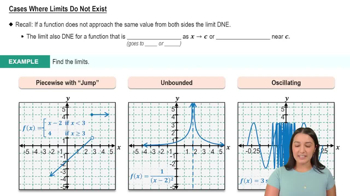
Cases Where Limits Do Not Exist

L’Hôpital’s Rule

L’Hôpital’s Rule is a method for evaluating limits that result in indeterminate forms like 0/0 or ∞/∞. It involves differentiating the numerator and denominator separately and then taking the limit of their quotient, simplifying the evaluation process.
Recommended video:

Inverse Trigonometric Functions and Their Limits

Inverse trigonometric functions, such as arctan(x), have specific limit behaviors as their arguments approach zero or infinity. Knowing that arctan(x) approaches π/2 as x → ∞ and 0 as x → 0 is essential for evaluating limits involving these functions.
Recommended video:
06:35
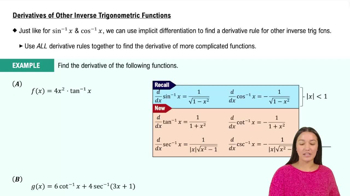
Derivatives of Other Inverse Trigonometric Functions