Ch. 7 - Transcendental Functions
Hass - Thomas' Calculus 15th Edition
Hass15th EditionThomas' CalculusISBN: 9780137616077Not the one you use?Change textbook
Chapter 7, Problem 7.5.71

Theory and Applications
L’Hôpital’s Rule does not help with the limits in Exercises 69–76. 
Try it—you just keep on cycling. Find the limits some other way.
71. lim (x → (π/2)⁻) sec x / tan x

Verified step by step guidance
1
Identify the limit expression: \(\lim_{x \to (\pi/2)^-} \frac{\sec x}{\tan x}\).
Rewrite the trigonometric functions in terms of sine and cosine to simplify the expression: \(\sec x = \frac{1}{\cos x}\) and \(\tan x = \frac{\sin x}{\cos x}\). Substitute these into the limit to get \(\lim_{x \to (\pi/2)^-} \frac{\frac{1}{\cos x}}{\frac{\sin x}{\cos x}}\).
Simplify the complex fraction by multiplying numerator and denominator appropriately: \(\frac{\frac{1}{\cos x}}{\frac{\sin x}{\cos x}} = \frac{1}{\cos x} \times \frac{\cos x}{\sin x} = \frac{1}{\sin x}\).
Now the limit reduces to \(\lim_{x \to (\pi/2)^-} \frac{1}{\sin x}\). Consider the behavior of \(\sin x\) as \(x\) approaches \(\pi/2\) from the left side.
Since \(\sin x\) approaches 1 as \(x\) approaches \(\pi/2\), analyze the limit \(\frac{1}{\sin x}\) accordingly to determine the limit value.

Verified video answer for a similar problem:

This video solution was recommended by our tutors as helpful for the problem above.
Video duration:
2m
Was this helpful?

Key Concepts

Here are the essential concepts you must grasp in order to answer the question correctly.

Behavior of Trigonometric Functions Near Specific Points

Understanding how functions like sec x and tan x behave as x approaches π/2 from the left is crucial. Near π/2, tan x tends to infinity, while sec x also grows large but their rates differ, affecting the limit's value.
Recommended video:
6:04
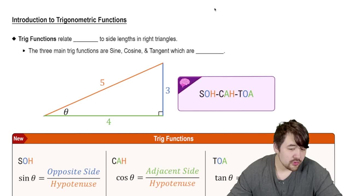
Introduction to Trigonometric Functions

Limits Involving Indeterminate Forms and Alternative Techniques

When L’Hôpital’s Rule leads to cyclic or unresolvable forms, alternative methods such as algebraic manipulation, trigonometric identities, or analyzing one-sided limits must be used to evaluate the limit.
Recommended video:
03:33
Integrals Involving Natural Logs: Substitution Example 7

One-Sided Limits and Directional Approach

Evaluating limits as x approaches π/2 from the left (denoted π/2⁻) requires considering the function's behavior just before π/2, which can differ from approaching from the right, impacting the limit's existence and value.
Recommended video:
05:50
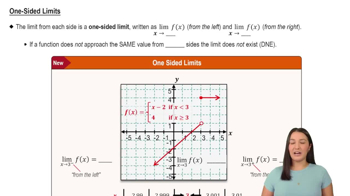
One-Sided Limits