Ch. 7 - Transcendental Functions
Hass - Thomas' Calculus 15th Edition
Hass15th EditionThomas' CalculusISBN: 9780137616077Not the one you use?Change textbook
Chapter 7, Problem 7.AAE.5

Find the limits in Exercises 1–6.
5. lim(n→∞) (1/(n+1) + 1/(n+2) + ... + 1/(2n))

Verified step by step guidance
1
Recognize that the expression is a sum of terms of the form \(\frac{1}{k}\) where \(k\) runs from \(n+1\) to \$2n$. This can be written as \(\sum_{k=n+1}^{2n} \frac{1}{k}\).
Recall that the harmonic series \(H_m = \sum_{k=1}^m \frac{1}{k}\) and use it to rewrite the sum as \(H_{2n} - H_n\).
Use the approximation for large \(n\): \(H_n \approx \ln(n) + \gamma\), where \(\gamma\) is the Euler-Mascheroni constant, to express \(H_{2n} - H_n\) as \(\ln(2n) + \gamma - (\ln(n) + \gamma)\).
Simplify the expression by canceling out \(\gamma\) and combining logarithms: \(\ln(2n) - \ln(n) = \ln\left(\frac{2n}{n}\right) = \ln(2)\).
Conclude that the limit as \(n \to \infty\) of the sum is \(\ln(2)\), since the approximation becomes exact in the limit.

Verified video answer for a similar problem:

This video solution was recommended by our tutors as helpful for the problem above.
Video duration:
2m
Was this helpful?

Key Concepts

Here are the essential concepts you must grasp in order to answer the question correctly.

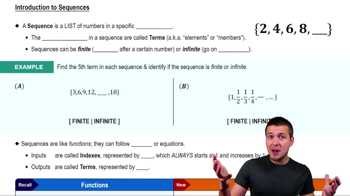
Limit of a Sequence

The limit of a sequence describes the value that the terms of the sequence approach as the index goes to infinity. Understanding how to evaluate limits helps determine the behavior of sequences and series for very large indices.
Recommended video:
Guided course
8:22
Introduction to Sequences

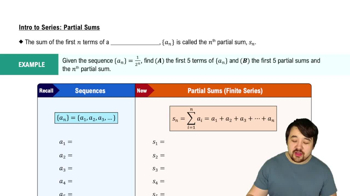
Harmonic Series and Partial Sums

The harmonic series is the sum of reciprocals of natural numbers. Partial sums of the harmonic series, such as sums from 1 to n, grow without bound but slowly. Recognizing partial sums helps analyze expressions involving sums of terms like 1/k.
Recommended video:
06:45
Intro to Series: Partial Sums

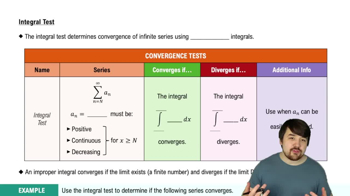
Integral Test and Approximation of Sums by Integrals

The integral test relates sums of sequences to definite integrals, allowing approximation of sums by integrals for large n. This technique is useful to estimate sums like 1/(n+1) + ... + 1/(2n) by comparing them to integrals of 1/x.
Recommended video:
07:25
Integral Test