Ch. 7 - Transcendental Functions
Hass - Thomas' Calculus 15th Edition
Hass15th EditionThomas' CalculusISBN: 9780137616077Not the one you use?Change textbook
Chapter 7, Problem 7.3.57

Solve the initial value problems in Exercises 55–58.


57. d²y/dx² = 2e^(−x),y(0) = 1,y′(0) = 0

Verified step by step guidance
1
Identify the given differential equation and initial conditions: \( \frac{d^{2}y}{dx^{2}} = 2e^{-x} \), with \( y(0) = 1 \) and \( y'(0) = 0 \).
Integrate the second derivative \( \frac{d^{2}y}{dx^{2}} \) once with respect to \( x \) to find the first derivative \( y'(x) \). This gives \( y'(x) = \int 2e^{-x} \, dx + C_1 \), where \( C_1 \) is a constant of integration.
Perform the integration \( \int 2e^{-x} \, dx \) by recalling that \( \int e^{ax} \, dx = \frac{1}{a} e^{ax} + C \). Substitute the result back to express \( y'(x) \) including the constant \( C_1 \).
Integrate \( y'(x) \) with respect to \( x \) to find \( y(x) \). This will introduce another constant of integration \( C_2 \). So, \( y(x) = \int y'(x) \, dx = \int (\text{expression from previous step}) \, dx + C_2 \).
Use the initial conditions \( y(0) = 1 \) and \( y'(0) = 0 \) to set up equations and solve for the constants \( C_1 \) and \( C_2 \). Substitute these constants back into the expression for \( y(x) \) to get the particular solution.

Verified video answer for a similar problem:

This video solution was recommended by our tutors as helpful for the problem above.
Video duration:
6m
Was this helpful?

Key Concepts

Here are the essential concepts you must grasp in order to answer the question correctly.

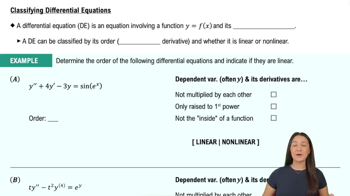
Second-Order Differential Equations

A second-order differential equation involves the second derivative of an unknown function. Solving it requires finding a function y(x) whose second derivative matches the given expression. The general solution often includes two arbitrary constants, reflecting the equation's order.
Recommended video:
07:39
Classifying Differential Equations

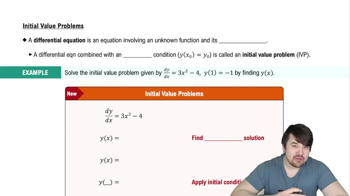
Initial Conditions and Initial Value Problems

Initial conditions specify the values of a function and its derivatives at a particular point, allowing determination of the arbitrary constants in the general solution. An initial value problem combines a differential equation with these conditions to find a unique solution.
Recommended video:
05:03
Initial Value Problems

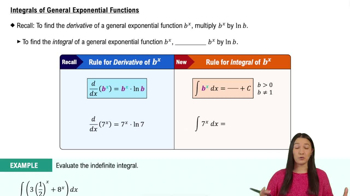
Integration of Exponential Functions

Solving the differential equation involves integrating the right-hand side function, here an exponential function e^(−x). Understanding how to integrate exponentials and apply constants of integration is essential to find the general solution before applying initial conditions.
Recommended video:
05:11
Integrals of General Exponential Functions