Ch. 7 - Transcendental Functions
Hass - Thomas' Calculus 15th Edition
Hass15th EditionThomas' CalculusISBN: 9780137616077Not the one you use?Change textbook
Chapter 7, Problem 7.6.77

Evaluate the integrals in Exercises 77–90.
77. ∫dx/√(-x²+4x-3)

Verified step by step guidance
1
Start by rewriting the expression under the square root to a more recognizable form. The integrand is \(\frac{1}{\sqrt{-x^{2} + 4x - 3}}\). Notice the quadratic inside the square root: \(-x^{2} + 4x - 3\).
Complete the square for the quadratic expression inside the square root. Factor out the negative sign first: \(-(x^{2} - 4x + 3)\). Then complete the square for \(x^{2} - 4x + 3\) by finding a perfect square trinomial.
Recall that \(x^{2} - 4x + 3 = (x - 2)^{2} - 1\) because \((x - 2)^{2} = x^{2} - 4x + 4\). Substitute this back to get \(-( (x - 2)^{2} - 1 ) = 1 - (x - 2)^{2}\) inside the square root.
Rewrite the integral as \(\int \frac{dx}{\sqrt{1 - (x - 2)^{2}}}\). This is a standard form that resembles the integral of \(\frac{1}{\sqrt{a^{2} - u^{2}}}\), which is related to the inverse sine function.
Use the substitution \(u = x - 2\), so \(du = dx\). The integral becomes \(\int \frac{du}{\sqrt{1 - u^{2}}}\). Recognize this as the integral of \(\frac{1}{\sqrt{1 - u^{2}}}\), whose antiderivative is \(\arcsin(u) + C\). Finally, substitute back \(u = x - 2\) to express the answer in terms of \(x\).

Verified video answer for a similar problem:

This video solution was recommended by our tutors as helpful for the problem above.
Video duration:
2m
Was this helpful?

Key Concepts

Here are the essential concepts you must grasp in order to answer the question correctly.

Completing the Square

Completing the square is a technique used to rewrite quadratic expressions in the form ax² + bx + c as (x - h)² + k. This simplifies the integrand, especially when dealing with square roots of quadratic expressions, making it easier to identify the integral's form and apply appropriate methods.
Recommended video:
05:22
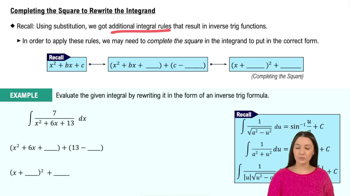
Completing the Square to Rewrite the Integrand

Integration of Functions Involving Square Roots

Integrals containing square roots of quadratic expressions often require substitution or recognition of standard integral forms. Understanding how to manipulate the integrand into a recognizable pattern, such as arcsine or logarithmic forms, is essential for evaluating these integrals.
Recommended video:
07:01
Integrals Involving Natural Logs: Substitution

Trigonometric Substitution

Trigonometric substitution replaces variables in integrals involving square roots of quadratic expressions with trigonometric functions, simplifying the integral. For example, substituting x = a sin θ or x = a cos θ transforms the square root into a trigonometric identity, facilitating easier integration.
Recommended video:
6:04
Introduction to Trigonometric Functions