
Ch. 7 - Transcendental Functions
Hass - Thomas' Calculus 15th Edition
Hass15th EditionThomas' CalculusISBN: 9780137616077Not the one you use?Change textbook
Chapter 7, Problem 7.1.51

Let f(x) = x³ − 3x² − 1, x ≥ 2. Find the value of df⁻¹/dx at the point x = −1 = f(3).

Verified step by step guidance
1
First, identify the function given: \(f(x) = x^{3} - 3x^{2} - 1\) with the domain \(x \geq 2\). We are asked to find the derivative of the inverse function \(f^{-1}(x)\) at the point where \(x = -1\), which corresponds to \(f(3) = -1\).
Recall the formula for the derivative of the inverse function: \(\frac{d}{dx} f^{-1}(x) = \frac{1}{f'(f^{-1}(x))}\). This means we need to find \(f'(x)\) and evaluate it at \(x = f^{-1}(-1)\), which is \(x=3\) since \(f(3) = -1\).
Compute the derivative of \(f(x)\): \(f'(x) = \frac{d}{dx} (x^{3} - 3x^{2} - 1) = 3x^{2} - 6x\).
Evaluate \(f'(x)\) at \(x=3\): substitute \(3\) into the derivative to get \(f'(3) = 3(3)^{2} - 6(3)\).
Finally, use the inverse derivative formula to find \(\frac{d}{dx} f^{-1}(-1) = \frac{1}{f'(3)}\). This gives the derivative of the inverse function at the point \(x = -1\).

Verified video answer for a similar problem:

This video solution was recommended by our tutors as helpful for the problem above.
Video duration:
2m
Was this helpful?

Key Concepts

Here are the essential concepts you must grasp in order to answer the question correctly.

Inverse Function and Its Derivative

The inverse function f⁻¹ reverses the effect of f, so f(f⁻¹(x)) = x. The derivative of the inverse at a point x is given by (df⁻¹/dx)(x) = 1 / (df/dx)(f⁻¹(x)), provided f is differentiable and its derivative is nonzero at that point.
Recommended video:
06:35
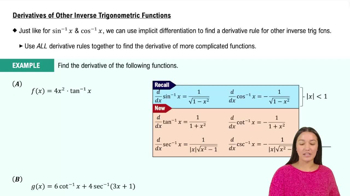
Derivatives of Other Inverse Trigonometric Functions

Chain Rule

The chain rule helps differentiate composite functions. For inverse functions, it relates the derivatives of f and f⁻¹ by differentiating the identity f(f⁻¹(x)) = x, leading to the formula for the derivative of the inverse function.
Recommended video:
05:02
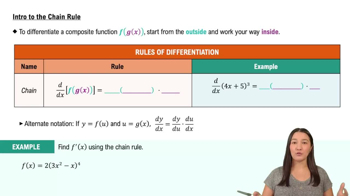
Intro to the Chain Rule

Evaluating Derivatives at Specific Points

To find the derivative of the inverse at a given x, identify the corresponding point y = f⁻¹(x). Then compute the derivative of f at y and use it to find (df⁻¹/dx)(x). This requires careful substitution and evaluation of the original function and its derivative.
Recommended video:
05:44
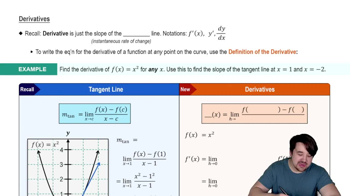
Derivatives