Ch. 7 - Transcendental Functions
Hass - Thomas' Calculus 15th Edition
Hass15th EditionThomas' CalculusISBN: 9780137616077Not the one you use?Change textbook
Chapter 7, Problem 7.1.35

Each of Exercises 25–36 gives a formula for a function y=f(x). In each case, find f^(-1)(x) and identify the domain and range of f^(-1). As a check, show that f(f^(-1)(x))=f^(-1)(f(x))=x.


f(x) = (x + b) / (x − 2), b > −2 and constant

Verified step by step guidance
1
Start by writing the function explicitly: \(f(x) = \frac{x + b}{x - 2}\), where \(b > -2\) is a constant.
To find the inverse function \(f^{-1}(x)\), set \(y = \frac{x + b}{x - 2}\) and then interchange \(x\) and \(y\) to get \(x = \frac{y + b}{y - 2}\).
Solve the equation \(x = \frac{y + b}{y - 2}\) for \(y\): multiply both sides by \((y - 2)\) to get \(x(y - 2) = y + b\), then expand and rearrange terms to isolate \(y\).
Express \(y\) in terms of \(x\) to find \(f^{-1}(x)\) explicitly. This will give you the formula for the inverse function.
Determine the domain and range of \(f^{-1}\) by considering the range and domain of \(f\), respectively, and verify the inverse relationship by checking that \(f(f^{-1}(x)) = x\) and \(f^{-1}(f(x)) = x\).

Verified video answer for a similar problem:

This video solution was recommended by our tutors as helpful for the problem above.
Video duration:
3m
Was this helpful?

Key Concepts

Here are the essential concepts you must grasp in order to answer the question correctly.

Inverse Functions

An inverse function reverses the effect of the original function, swapping inputs and outputs. For a function f(x), its inverse f⁻¹(x) satisfies f(f⁻¹(x)) = x and f⁻¹(f(x)) = x. Finding the inverse involves solving y = f(x) for x in terms of y.
Recommended video:
4:49
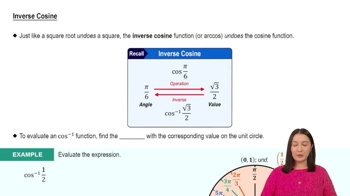
Inverse Cosine

Domain and Range of Functions and Their Inverses

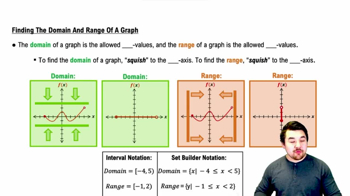
The domain of a function is the set of all possible input values, while the range is the set of all possible output values. For inverse functions, the domain and range swap roles: the domain of f becomes the range of f⁻¹, and vice versa. Identifying these sets ensures the inverse is well-defined.
Recommended video:
5:10
Finding the Domain and Range of a Graph

Rational Functions and Restrictions

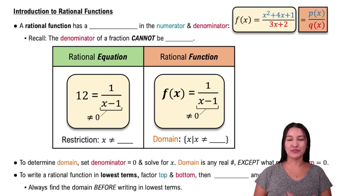
A rational function is a ratio of polynomials, which may have restrictions where the denominator is zero. For f(x) = (x + b)/(x − 2), x ≠ 2 to avoid division by zero. Such restrictions affect the domain and range and must be considered when finding inverses.
Recommended video:
6:04
Intro to Rational Functions