Ch. 7 - Transcendental Functions
Hass - Thomas' Calculus 15th Edition
Hass15th EditionThomas' CalculusISBN: 9780137616077Not the one you use?Change textbook
Chapter 7, Problem 7.2.16

In Exercises 7–38, find the derivative of y with respect to x, t, or θ, as appropriate.
16. y = (ln x)³

Verified step by step guidance
1
Identify the function given: \(y = (\ln x)^3\). This is a composite function where the outer function is \(u^3\) and the inner function is \(u = \ln x\).
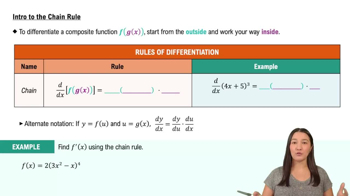
Apply the chain rule for differentiation, which states that if \(y = f(g(x))\), then \(\frac{dy}{dx} = f'(g(x)) \cdot g'(x)\).
Differentiate the outer function \(u^3\) with respect to \(u\): \(\frac{d}{du}(u^3) = 3u^2\).
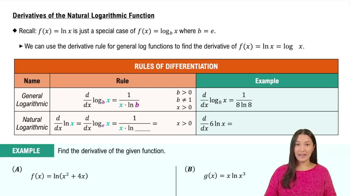
Differentiate the inner function \(u = \ln x\) with respect to \(x\): \(\frac{d}{dx}(\ln x) = \frac{1}{x}\).
Combine the results using the chain rule: \(\frac{dy}{dx} = 3(\ln x)^2 \cdot \frac{1}{x}\).

Verified video answer for a similar problem:

This video solution was recommended by our tutors as helpful for the problem above.
Video duration:
2m
Was this helpful?

Key Concepts

Here are the essential concepts you must grasp in order to answer the question correctly.

Chain Rule

The chain rule is used to differentiate composite functions. It states that the derivative of a function composed of another function is the derivative of the outer function evaluated at the inner function times the derivative of the inner function. For example, if y = (ln x)³, treat (ln x) as the inner function and cube as the outer function.
Recommended video:
05:02
Intro to the Chain Rule

Derivative of the Natural Logarithm Function

The derivative of ln x with respect to x is 1/x. This is fundamental when differentiating expressions involving logarithms. Knowing this allows you to find the derivative of functions like (ln x)³ by applying the chain rule.
Recommended video:
05:18
Derivative of the Natural Logarithmic Function

Power Rule

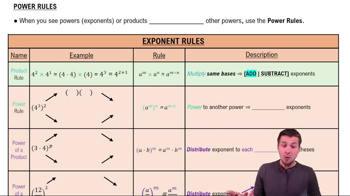
The power rule states that the derivative of xⁿ is n*xⁿ⁻¹. When differentiating (ln x)³, the power rule applies to the outer function (raising to the third power), which helps simplify the differentiation process when combined with the chain rule.
Recommended video: