Ch. 7 - Transcendental Functions
Hass - Thomas' Calculus 15th Edition
Hass15th EditionThomas' CalculusISBN: 9780137616077Not the one you use?Change textbook
Chapter 7, Problem 7.6.25

In Exercises 21–48, find the derivative of y with respect to the appropriate variable.
25. y=arcsec(2s+1)

Verified step by step guidance
1
Identify the function given: \(y = \arcsec(2s + 1)\). We need to find \(\frac{dy}{ds}\), the derivative of \(y\) with respect to \(s\).
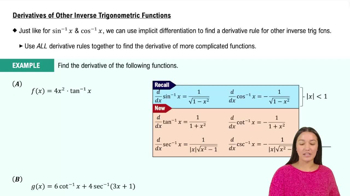
Recall the derivative formula for \(y = \arcsec(u)\), where \(u\) is a function of \(s\): \(\frac{dy}{ds} = \frac{1}{|u| \sqrt{u^2 - 1}} \cdot \frac{du}{ds}\).
Set \(u = 2s + 1\). Compute the derivative of \(u\) with respect to \(s\): \(\frac{du}{ds} = 2\).
Substitute \(u\) and \(\frac{du}{ds}\) into the derivative formula: \(\frac{dy}{ds} = \frac{1}{|2s + 1| \sqrt{(2s + 1)^2 - 1}} \cdot 2\).
Simplify the expression inside the square root and write the final derivative expression in terms of \(s\), leaving it in simplified radical form without calculating the numeric value.

Verified video answer for a similar problem:

This video solution was recommended by our tutors as helpful for the problem above.
Video duration:
3m
Was this helpful?

Key Concepts

Here are the essential concepts you must grasp in order to answer the question correctly.

Derivative of Inverse Trigonometric Functions

Inverse trigonometric functions like arcsec(x) have specific derivative formulas. Understanding these formulas is essential to differentiate functions involving inverse trig expressions correctly.
Recommended video:
06:35
Derivatives of Other Inverse Trigonometric Functions

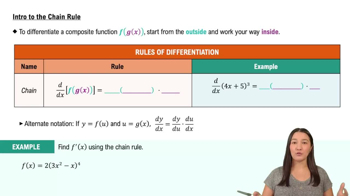
Chain Rule

The chain rule is used to differentiate composite functions. When the argument of arcsec is a function of x, such as 2s+1, the derivative of the outer function is multiplied by the derivative of the inner function.
Recommended video:
05:02
Intro to the Chain Rule

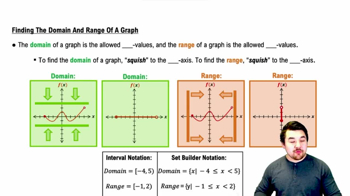
Domain and Differentiability of arcsec(x)

The function arcsec(x) is defined for |x| ≥ 1, and its derivative involves expressions with sqrt(x^2 - 1). Recognizing the domain restrictions and the form of the derivative helps avoid errors in differentiation.
Recommended video:
5:10
Finding the Domain and Range of a Graph