Ch. 7 - Transcendental Functions
Hass - Thomas' Calculus 15th Edition
Hass15th EditionThomas' CalculusISBN: 9780137616077Not the one you use?Change textbook
Chapter 7, Problem 7.3.112

Evaluate the integrals in Exercises 111–114.
112. ∫₁^(eˣ) (1 / t) dt

Verified step by step guidance
1
Recognize that the integral is a definite integral with variable upper limit: \(\int_1^{e^x} \frac{1}{t} \, dt\).
Recall the Fundamental Theorem of Calculus Part 1, which states that if \(F(x) = \int_a^{g(x)} f(t) \, dt\), then \(F'(x) = f(g(x)) \cdot g'(x)\).
Identify the integrand function as \(f(t) = \frac{1}{t}\) and the upper limit as \(g(x) = e^x\).
Apply the Fundamental Theorem of Calculus to differentiate the integral with respect to \(x\): \(\frac{d}{dx} \int_1^{e^x} \frac{1}{t} \, dt = \frac{1}{e^x} \cdot \frac{d}{dx} (e^x)\).
Calculate the derivative of the upper limit: \(\frac{d}{dx} (e^x) = e^x\), then multiply by the integrand evaluated at \(e^x\) to get the derivative of the integral.

Verified video answer for a similar problem:

This video solution was recommended by our tutors as helpful for the problem above.
Video duration:
2m
Was this helpful?

Key Concepts

Here are the essential concepts you must grasp in order to answer the question correctly.

Definite Integral with Variable Limits

A definite integral with variable limits involves integrating a function where the upper or lower limit is a function of a variable, such as e^x. Understanding how to handle these limits is essential for evaluating the integral correctly.
Recommended video:
05:43
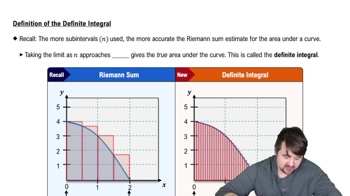
Definition of the Definite Integral

Fundamental Theorem of Calculus

This theorem connects differentiation and integration, stating that if F is an antiderivative of f, then the definite integral of f from a to b equals F(b) - F(a). It allows evaluating integrals by finding antiderivatives.
Recommended video:
06:11
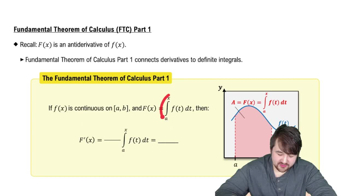
Fundamental Theorem of Calculus Part 1

Integral of 1/t

The integral of 1/t with respect to t is the natural logarithm function, ln|t| + C. Recognizing this integral form is crucial for solving the given problem, especially when evaluating definite integrals involving 1/t.
Recommended video:
09:15
Tabular Integration by Parts Example 6