Ch. 7 - Transcendental Functions
Hass - Thomas' Calculus 15th Edition
Hass15th EditionThomas' CalculusISBN: 9780137616077Not the one you use?Change textbook
Chapter 7, Problem 7.7.23

In Exercises 13–24, find the derivative of y with respect to the appropriate variable.
23. y = (x²+1)sech(ln x)
(Hint: Before differentiating, express in terms of exponentials and simplify.)

Verified step by step guidance
1
Recognize that the function is a product of two functions: \(y = (x^{2} + 1) \cdot \text{sech}(\ln x)\). We will need to use the product rule for differentiation, which states: \(\frac{d}{dx}[u \cdot v] = u'v + uv'\).
Rewrite the hyperbolic secant function in terms of exponentials. Recall that \(\text{sech}(z) = \frac{2}{e^{z} + e^{-z}}\). So, \(\text{sech}(\ln x) = \frac{2}{e^{\ln x} + e^{-\ln x}}\).
Simplify the expression inside the denominator using properties of logarithms and exponentials: \(e^{\ln x} = x\) and \(e^{-\ln x} = \frac{1}{x}\). Thus, \(\text{sech}(\ln x) = \frac{2}{x + \frac{1}{x}}\).
Simplify the denominator further by combining terms: \(x + \frac{1}{x} = \frac{x^{2} + 1}{x}\). Therefore, \(\text{sech}(\ln x) = \frac{2}{\frac{x^{2} + 1}{x}} = \frac{2x}{x^{2} + 1}\).
Rewrite the original function using this simplification: \(y = (x^{2} + 1) \cdot \frac{2x}{x^{2} + 1}\). Notice that \((x^{2} + 1)\) cancels out, so \(y = 2x\). Now, differentiate \(y = 2x\) with respect to \(x\) using basic differentiation rules.

Verified video answer for a similar problem:

This video solution was recommended by our tutors as helpful for the problem above.
Video duration:
3m
Was this helpful?

Key Concepts

Here are the essential concepts you must grasp in order to answer the question correctly.

Hyperbolic Secant Function and Its Exponential Form

The hyperbolic secant function, sech(x), can be expressed using exponentials as sech(x) = 2 / (e^x + e^(-x)). This form simplifies differentiation by converting hyperbolic functions into exponential terms, making it easier to apply derivative rules.
Recommended video:
6:13
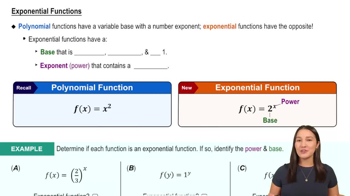
Exponential Functions

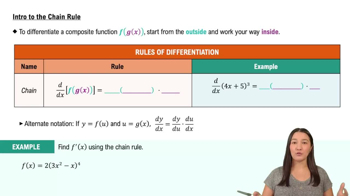
Chain Rule

The chain rule is used to differentiate composite functions. When a function is nested inside another, such as sech(ln x), the derivative is the derivative of the outer function evaluated at the inner function times the derivative of the inner function.
Recommended video:
05:02
Intro to the Chain Rule

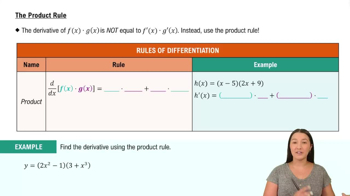
Product Rule

The product rule is applied when differentiating the product of two functions, like (x² + 1) and sech(ln x). It states that the derivative is the first function times the derivative of the second plus the second function times the derivative of the first.
Recommended video:
05:18
The Product Rule