Ch. 7 - Transcendental Functions
Hass - Thomas' Calculus 15th Edition
Hass15th EditionThomas' CalculusISBN: 9780137616077Not the one you use?Change textbook
Chapter 7, Problem 7.2.77

77. The region in the first quadrant bounded by the coordinate axes, the line y=3, and the curve x=2/√(y+1) is revolved about the y-axis to generate a solid. Find the volume of the solid.

Verified step by step guidance
1
Identify the region bounded by the coordinate axes (x=0 and y=0), the horizontal line y=3, and the curve x=\(\frac{2}{\sqrt{y+1}\)} in the first quadrant. This region will be revolved around the y-axis to form the solid.
Since the solid is generated by revolving around the y-axis, use the method of cylindrical shells or the disk/washer method. Here, the disk/washer method is convenient because the slices perpendicular to the y-axis are horizontal.
Express the radius and height of the disks in terms of y. The radius of each disk is the x-value from the y-axis to the curve, which is given by x=\(\frac{2}{\sqrt{y+1}\)}. The thickness of each disk is an infinitesimal change in y, denoted by dy.
Write the volume integral using the disk method formula: V = \(\int\)_{y=0}^{y=3} \(\pi\) \(\times\) (\(\text{radius}\))^2 \, dy = \(\int\)_0^3 \(\pi\) \(\left\)( \(\frac{2}{\sqrt{y+1}\)} \(\right\))^2 dy.
Simplify the integrand inside the integral and set up the integral for evaluation. The integral becomes V = \(\pi\) \(\int\)_0^3 \(\frac{4}{y+1}\) \, dy. This integral can then be evaluated to find the volume.

Verified video answer for a similar problem:

This video solution was recommended by our tutors as helpful for the problem above.
Video duration:
4m
Was this helpful?

Key Concepts

Here are the essential concepts you must grasp in order to answer the question correctly.

Setting up the volume integral using the shell method

When a region is revolved around the y-axis, the shell method involves integrating cylindrical shells parallel to the axis of rotation. Each shell's volume is 2π(radius)(height)(thickness), where radius is the distance from the y-axis and height is the function value. This method is useful when the function is given in terms of y or when integrating with respect to y.
Recommended video:
04:48
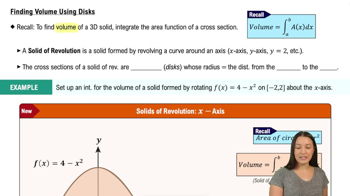
Finding Volume Using Disks

Understanding the boundaries of the region

The region is bounded by the coordinate axes (x=0, y=0), the line y=3, and the curve x = 2/√(y+1). Identifying these boundaries helps determine the limits of integration and the shape of the solid. Since the region lies in the first quadrant, x and y are non-negative, and y ranges from 0 to 3.
Recommended video:
07:45
Area of Polar Regions

Expressing the radius and height in terms of y

For revolution about the y-axis, the radius of each shell is the x-value, and the height corresponds to the thickness in y. Here, the radius is x, given by the curve x = 2/√(y+1), and the height is the difference between the outer boundary and the axis, which is from x=0 to the curve. Expressing these correctly allows setting up the integral for volume.
Recommended video:
06:18
Introduction to Cross Sections Example 2