Ch. 7 - Transcendental Functions
Hass - Thomas' Calculus 15th Edition
Hass15th EditionThomas' CalculusISBN: 9780137616077Not the one you use?Change textbook
Chapter 7, Problem 7.PE.9

In Exercises 1–24, find the derivative of y with respect to the appropriate variable.
9. y = 8^(-t)

Verified step by step guidance
1
Identify the function given: \(y = 8^{-t}\). Here, the base is a constant (8) and the exponent is a function of \(t\) (specifically, \(-t\)).
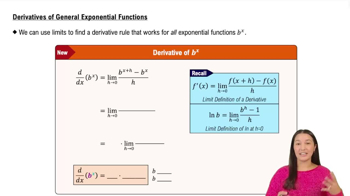
Recall the derivative rule for exponential functions with a constant base: If \(y = a^{u}\) where \(a\) is a positive constant and \(u\) is a function of \(t\), then the derivative is \(\frac{dy}{dt} = a^{u} \cdot \ln(a) \cdot \frac{du}{dt}\).
In this problem, set \(a = 8\) and \(u = -t\). Next, find the derivative of the exponent \(u\) with respect to \(t\): \(\frac{du}{dt} = \frac{d}{dt}(-t) = -1\).
Apply the formula: \(\frac{dy}{dt} = 8^{-t} \cdot \ln(8) \cdot (-1)\).
Simplify the expression if needed, keeping the derivative in terms of \(t\) and constants, but do not calculate the numerical value of \(\ln(8)\).

Verified video answer for a similar problem:

This video solution was recommended by our tutors as helpful for the problem above.
Video duration:
1m
Was this helpful?

Key Concepts

Here are the essential concepts you must grasp in order to answer the question correctly.

Derivative of Exponential Functions

The derivative of an exponential function a^x, where a is a positive constant, is found using the formula d/dx(a^x) = a^x * ln(a). This rule applies when the exponent is a variable, allowing us to differentiate expressions like 8^(-t).
Recommended video:
04:50
Derivatives of General Exponential Functions

Chain Rule

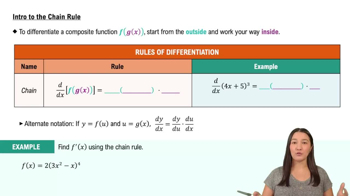
The chain rule is used to differentiate composite functions. When the exponent is a function of the variable, such as -t, the derivative is the derivative of the outer function times the derivative of the inner function. For y = 8^(-t), we multiply by the derivative of -t.
Recommended video:
05:02
Intro to the Chain Rule

Natural Logarithm (ln)

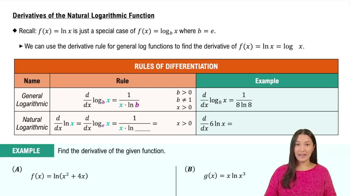
The natural logarithm ln(a) appears in the derivative of exponential functions with base a. It is the logarithm to the base e and is essential for expressing the rate of change of functions like 8^(-t), since the derivative involves multiplying by ln(8).
Recommended video:
05:18
Derivative of the Natural Logarithmic Function