Ch. 7 - Transcendental Functions
Hass - Thomas' Calculus 15th Edition
Hass15th EditionThomas' CalculusISBN: 9780137616077Not the one you use?Change textbook
Chapter 7, Problem 7.PE.35

Evaluate the integrals in Exercises 31–78.
35. ∫sec²x e^(tan x)dx

Verified step by step guidance
1
Recognize that the integral involves the function \(e^{\tan x}\) multiplied by \(\sec^2 x\). This suggests a substitution related to the derivative of \(\tan x\).
Recall that the derivative of \(\tan x\) is \(\sec^2 x\), which matches the factor multiplying \(e^{\tan x}\) in the integral.
Set the substitution \(u = \tan x\), so that \(du = \sec^2 x \, dx\). This allows us to rewrite the integral in terms of \(u\).
Rewrite the integral as \(\int e^u \, du\), which is a standard integral involving the exponential function.
Integrate \(e^u\) with respect to \(u\) to get \(e^u + C\), then substitute back \(u = \tan x\) to express the answer in terms of \(x\).

Verified video answer for a similar problem:

This video solution was recommended by our tutors as helpful for the problem above.
Video duration:
1m
Was this helpful?

Key Concepts

Here are the essential concepts you must grasp in order to answer the question correctly.

Integration by Substitution

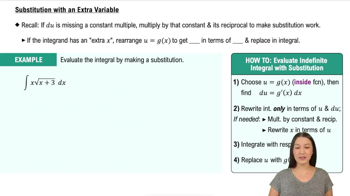
Integration by substitution is a method used to simplify integrals by changing variables. It involves identifying a part of the integrand whose derivative is also present, allowing the integral to be rewritten in terms of a new variable. This technique is especially useful when the integral contains a composite function.
Recommended video:
04:27
Substitution With an Extra Variable

Derivative of the Tangent Function

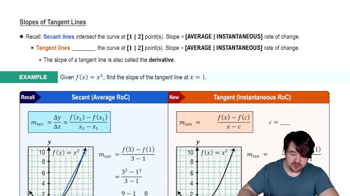
The derivative of tan(x) is sec²(x). Recognizing this relationship helps in integration problems where sec²(x) appears alongside functions of tan(x). This connection often suggests using tan(x) as a substitution variable to simplify the integral.
Recommended video:
05:13
Slopes of Tangent Lines

Exponential Functions in Integration

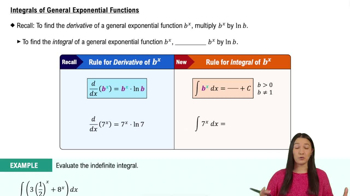
Exponential functions like e^(tan x) maintain their form under differentiation and integration, making them straightforward to handle once the substitution is made. Understanding how to integrate expressions involving exponentials combined with trigonometric functions is key to solving such integrals.
Recommended video:
05:11
Integrals of General Exponential Functions