
Ch. 7 - Transcendental Functions
Hass - Thomas' Calculus 15th Edition
Hass15th EditionThomas' CalculusISBN: 9780137616077Not the one you use?Change textbook
Chapter 7, Problem 7.3.128

For Exercises 127 and 128 find a function f satisfying each equation.
128. f(x) = e² + ∫₁ˣ f(t) dt

Verified step by step guidance
1
Start by recognizing that the given equation defines the function \( f(x) \) in terms of an integral involving itself: \( f(x) = e^{2} + \int_{1}^{x} f(t) \, dt \). This is an integral equation that can be converted into a differential equation by differentiation.
Differentiate both sides of the equation with respect to \( x \). Using the Fundamental Theorem of Calculus, the derivative of the integral \( \int_{1}^{x} f(t) \, dt \) with respect to \( x \) is \( f(x) \). So, differentiating gives: \( f'(x) = 0 + f(x) \), since \( e^{2} \) is a constant.
Rewrite the resulting differential equation: \( f'(x) = f(x) \). This is a first-order linear differential equation whose general solution is well-known.
Solve the differential equation \( f'(x) = f(x) \). The general solution has the form \( f(x) = Ce^{x} \), where \( C \) is a constant to be determined.
Use the original equation to find the constant \( C \). Substitute \( f(x) = Ce^{x} \) back into the integral equation and solve for \( C \) by evaluating at \( x = 1 \) or by matching both sides of the equation.

Verified video answer for a similar problem:

This video solution was recommended by our tutors as helpful for the problem above.
Video duration:
8m
Was this helpful?

Key Concepts

Here are the essential concepts you must grasp in order to answer the question correctly.

Integral Equations

An integral equation involves an unknown function under an integral sign. Solving such equations often requires transforming them into differential equations or using known methods to find functions that satisfy the given integral relationship.
Recommended video:
Guided course
08:02
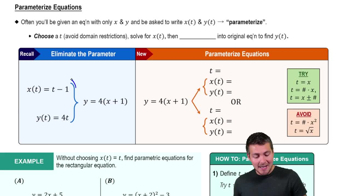
Parameterizing Equations

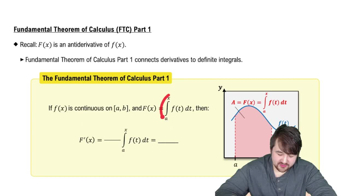
Fundamental Theorem of Calculus

This theorem links differentiation and integration, stating that if a function is defined as an integral with a variable upper limit, its derivative is the integrand evaluated at that limit. It allows converting integral equations into differential equations.
Recommended video:
06:11
Fundamental Theorem of Calculus Part 1

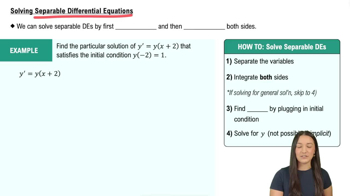
Solving First-Order Differential Equations

After differentiating the integral equation, you typically get a first-order differential equation. Techniques such as separation of variables or integrating factors help find the explicit form of the function satisfying the original equation.
Recommended video:
06:06
Solving Separable Differential Equations