Ch. 7 - Transcendental Functions
Hass - Thomas' Calculus 15th Edition
Hass15th EditionThomas' CalculusISBN: 9780137616077Not the one you use?Change textbook
Chapter 7, Problem 7.4.25

25. First-order chemical reactions In some chemical reactions, the rate at which the amount of a substance changes with time is proportional to the amount present. For the change of δ-gluconolactone into gluconic acid, for example,
dy/dt = -0.6y
when t is measured in hours. If there are 100 grams of δ-gluconolactone present when t=0, how many grams will be left after the first hour?

Verified step by step guidance
1
Recognize that the differential equation given is a first-order linear ordinary differential equation of the form \(\frac{dy}{dt} = ky\), where \(k\) is a constant. Here, \(k = -0.6\), indicating the amount decreases over time.
Write the general solution to the differential equation \(\frac{dy}{dt} = -0.6y\). This is a separable equation, and its solution can be expressed as \(y(t) = y_0 e^{kt}\), where \(y_0\) is the initial amount at \(t=0\).
Identify the initial condition from the problem: at \(t=0\), \(y = 100\) grams. Substitute this into the general solution to find the specific solution for this problem: \(y(t) = 100 e^{-0.6t}\).
To find the amount left after the first hour, substitute \(t=1\) into the specific solution: \(y(1) = 100 e^{-0.6 \times 1}\).
Evaluate the expression \(100 e^{-0.6}\) to find the amount of \(\delta\)-gluconolactone remaining after one hour (note: do not calculate the numerical value here, just set up the expression).

Verified video answer for a similar problem:

This video solution was recommended by our tutors as helpful for the problem above.
Video duration:
3m
Was this helpful?

Key Concepts

Here are the essential concepts you must grasp in order to answer the question correctly.

First-Order Differential Equations

A first-order differential equation relates a function and its first derivative. In this problem, the rate of change of the substance's amount is proportional to the amount itself, leading to an equation of the form dy/dt = ky. Solving such equations typically involves separation of variables or recognizing the exponential decay/growth pattern.
Recommended video:
07:39
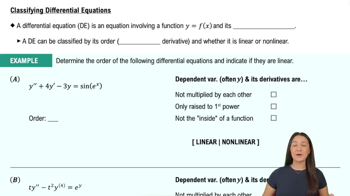
Classifying Differential Equations

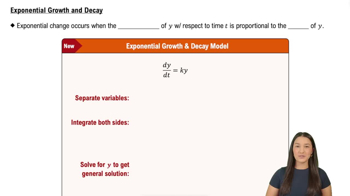
Exponential Decay

Exponential decay describes processes where a quantity decreases at a rate proportional to its current value. The solution to dy/dt = -ky is y(t) = y(0)e^(-kt), showing how the amount decreases over time. This model applies to many natural phenomena, including radioactive decay and chemical reactions.
Recommended video:
09:29
Exponential Growth & Decay

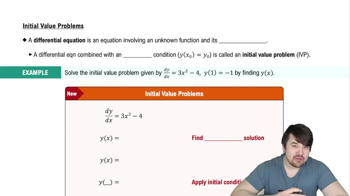
Initial Conditions and Solution Evaluation

Initial conditions specify the value of the function at a starting point, allowing determination of constants in the solution. Here, y(0) = 100 grams sets the initial amount. Using this, we can find the exact amount remaining after a given time by substituting t into the solution formula.
Recommended video:
05:03
Initial Value Problems