Ch. 7 - Transcendental Functions
Hass - Thomas' Calculus 15th Edition
Hass15th EditionThomas' CalculusISBN: 9780137616077Not the one you use?Change textbook
Chapter 7, Problem 7.PE.67

Evaluate the integrals in Exercises 31–78.
67. ∫(from -2 to 2)3dt/(4+3t²)

Verified step by step guidance
1
Recognize that the integral is a definite integral of the form \(\int_{-2}^{2} \frac{3}{4 + 3t^{2}} \, dt\). Notice that the integrand is an even function because \(t^{2}\) is even, so \(f(-t) = f(t)\).
Use the property of even functions in definite integrals: \(\int_{-a}^{a} f(t) \, dt = 2 \int_{0}^{a} f(t) \, dt\). This allows us to rewrite the integral as \(2 \int_{0}^{2} \frac{3}{4 + 3t^{2}} \, dt\).
Factor constants out of the integral where possible: \(2 \times 3 = 6\), so the integral becomes \(6 \int_{0}^{2} \frac{1}{4 + 3t^{2}} \, dt\).
To integrate \(\int \frac{1}{4 + 3t^{2}} \, dt\), rewrite the denominator to match the form \(a^{2} + u^{2}\), which is suitable for the arctangent integration formula. Express \(4 + 3t^{2}\) as \(2^{2} + (\sqrt{3} t)^{2}\).
Use the substitution \(u = \sqrt{3} t\), so \(dt = \frac{du}{\sqrt{3}}\). Rewrite the integral in terms of \(u\) and apply the formula \(\int \frac{1}{a^{2} + u^{2}} \, du = \frac{1}{a} \arctan \left( \frac{u}{a} \right) + C\). Then substitute back and evaluate the definite integral from \(t=0\) to \(t=2\).

Verified video answer for a similar problem:

This video solution was recommended by our tutors as helpful for the problem above.
Video duration:
5m
Was this helpful?

Key Concepts

Here are the essential concepts you must grasp in order to answer the question correctly.

Definite Integrals

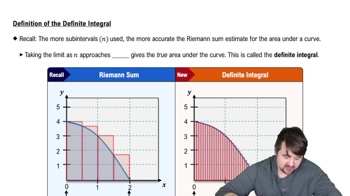
A definite integral calculates the net area under a curve between two specific limits. It is represented as ∫ from a to b of f(t) dt, where a and b are the lower and upper bounds. The result is a number representing the accumulated value of the function over that interval.
Recommended video:
05:43
Definition of the Definite Integral

Integration of Rational Functions

Rational functions are ratios of polynomials, and integrating them often involves recognizing standard forms or using substitution. For integrals like ∫ 1/(a + bt²) dt, the antiderivative typically involves inverse trigonometric functions such as arctangent.
Recommended video:
6:04
Intro to Rational Functions

Even Functions and Symmetry in Integration

An even function satisfies f(-t) = f(t), meaning its graph is symmetric about the y-axis. When integrating an even function over symmetric limits [-a, a], the integral equals twice the integral from 0 to a, simplifying calculations.
Recommended video:
05:11
Integrals of General Exponential Functions