Ch. 7 - Transcendental Functions
Hass - Thomas' Calculus 15th Edition
Hass15th EditionThomas' CalculusISBN: 9780137616077Not the one you use?Change textbook
Chapter 7, Problem 7.PE.109b

109. Does f grow faster, slower, or at the same rate as g as x→∞? Give reasons for your answers.
b. f(x)=x, g(x)=x + 1/x

Verified step by step guidance
1
Identify the given functions: \(f(x) = x\) and \(g(x) = x + \frac{1}{x}\).
As \(x \to \infty\), analyze the behavior of each function. For \(f(x) = x\), the function grows without bound linearly.
For \(g(x) = x + \frac{1}{x}\), note that \(\frac{1}{x} \to 0\) as \(x \to \infty\), so \(g(x)\) behaves like \(x\) plus a very small positive term.
Compare the growth rates by considering the ratio \(\frac{f(x)}{g(x)} = \frac{x}{x + \frac{1}{x}}\). Simplify this expression to understand the limit as \(x \to \infty\).
Evaluate the limit \(\lim_{x \to \infty} \frac{f(x)}{g(x)}\) to determine if it approaches 0, a finite nonzero constant, or infinity, which tells us if \(f\) grows slower, at the same rate, or faster than \(g\) respectively.

Verified video answer for a similar problem:

This video solution was recommended by our tutors as helpful for the problem above.
Video duration:
2m
Was this helpful?

Key Concepts

Here are the essential concepts you must grasp in order to answer the question correctly.

Asymptotic Behavior of Functions

Asymptotic behavior describes how functions behave as the input grows very large (x→∞). It helps compare growth rates by focusing on dominant terms and ignoring smaller ones that become insignificant at infinity.
Recommended video:
5:50
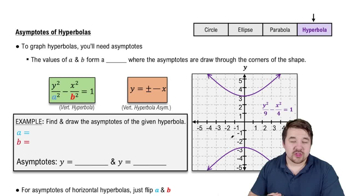
Asymptotes of Hyperbolas

Limits and Limit Comparison

Limits evaluate the value a function approaches as x approaches infinity. Comparing the limit of the ratio f(x)/g(x) as x→∞ determines if one function grows faster, slower, or at the same rate as the other.
Recommended video:
07:45
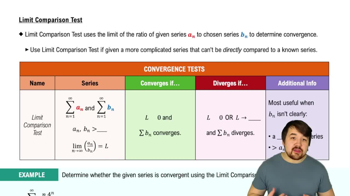
Limit Comparison Test

Dominant Terms in Functions

The dominant term in a function is the part that grows fastest as x→∞. For example, in g(x) = x + 1/x, the term x dominates because 1/x approaches zero, so the growth rate is mainly determined by x.
Recommended video:
05:44
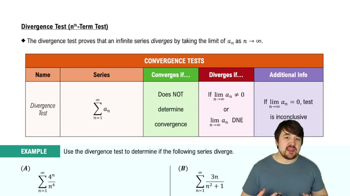
Divergence Test (nth Term Test)