Ch. 7 - Transcendental Functions
Hass - Thomas' Calculus 15th Edition
Hass15th EditionThomas' CalculusISBN: 9780137616077Not the one you use?Change textbook
Chapter 7, Problem 7.P.111e

111. True, or false? Give reasons for your answers.
e. arctan x = O(1)

Verified step by step guidance
1
Recall the definition of Big O notation: a function \(f(x)\) is \(O(1)\) as \(x \to \infty\) if there exists a constant \(M\) such that \(|f(x)| \leq M\) for all sufficiently large \(x\).
Consider the behavior of \(\arctan x\) as \(x \to \infty\). The arctangent function approaches a finite limit, specifically \(\frac{\pi}{2}\).
Since \(\arctan x\) approaches a finite constant, it is bounded for all \(x\), meaning there exists some constant \(M\) such that \(|\arctan x| \leq M\) for all \(x\).
Therefore, by the definition of Big O notation, \(\arctan x\) is indeed \(O(1)\) as \(x \to \infty\) because it does not grow without bound but stays within a fixed range.
Conclude that the statement '\(\arctan x = O(1)\)' is true, and the reasoning is based on the boundedness and finite limit of the arctangent function.

Verified video answer for a similar problem:

This video solution was recommended by our tutors as helpful for the problem above.
Video duration:
1m
Was this helpful?

Key Concepts

Here are the essential concepts you must grasp in order to answer the question correctly.

Big O Notation

Big O notation describes the upper bound of a function's growth rate as the input approaches a limit, often infinity. It characterizes how a function behaves asymptotically, ignoring constant factors and lower-order terms. For example, f(x) = O(1) means the function is bounded by a constant as x grows large.
Recommended video:
04:22
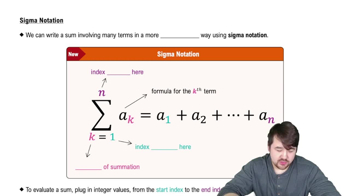
Sigma Notation

Behavior of arctan(x) as x → ∞

The arctan function approaches a finite limit, π/2, as x approaches infinity. This means arctan(x) is bounded and does not grow without bound, which is crucial when analyzing its asymptotic behavior or classifying it using Big O notation.
Recommended video:
03:39
Integrals of Natural Exponential Functions (e^x)

Asymptotic Boundedness

A function is asymptotically bounded if it remains within fixed limits as the input grows large. Since arctan(x) approaches π/2, it is bounded above and below, making it a constant order function, which aligns with the definition of O(1).
Recommended video:
5:50
Asymptotes of Hyperbolas