Ch. 7 - Transcendental Functions
Hass - Thomas' Calculus 15th Edition
Hass15th EditionThomas' CalculusISBN: 9780137616077Not the one you use?Change textbook
Chapter 7, Problem 7.P.111c

111. True, or false? Give reasons for your answers.
c. x = o(x + ln(x))

Verified step by step guidance
1
Understand the notation: The expression \(x = o(x + \ln(x))\) means that \(x\) is a little-o of \(x + \ln(x)\) as \(x\) approaches some limit (usually \(\infty\) or 0). This implies that \(\lim_{x \to a} \frac{x}{x + \ln(x)} = 0\), where \(a\) is the point of interest.
Determine the limit point: Since \(\ln(x)\) is defined for \(x > 0\), the natural domain to consider is \(x \to \infty\) or \(x \to 0^+\). We will analyze the limit \(\lim_{x \to \infty} \frac{x}{x + \ln(x)}\).
Set up the limit: Write the ratio explicitly as \(\lim_{x \to \infty} \frac{x}{x + \ln(x)}\) and consider the behavior of numerator and denominator as \(x\) grows large.
Simplify the expression inside the limit by dividing numerator and denominator by \(x\): \(\lim_{x \to \infty} \frac{1}{1 + \frac{\ln(x)}{x}}\).
Evaluate the limit: Since \(\frac{\ln(x)}{x} \to 0\) as \(x \to \infty\), the limit becomes \(\frac{1}{1 + 0} = 1\), which is not zero. Therefore, \(x\) is not \(o(x + \ln(x))\) as \(x \to \infty\).

Verified video answer for a similar problem:

This video solution was recommended by our tutors as helpful for the problem above.
Video duration:
2m
Was this helpful?

Key Concepts

Here are the essential concepts you must grasp in order to answer the question correctly.

Little-o Notation (o-notation)

Little-o notation describes the limiting behavior of a function relative to another as the input approaches a point, usually zero or infinity. Specifically, f(x) = o(g(x)) means that f(x) grows much slower than g(x), or equivalently, the limit of f(x)/g(x) as x approaches the point is zero.
Recommended video:
04:22
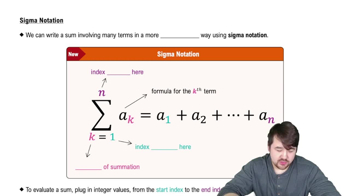
Sigma Notation

Behavior of the Natural Logarithm Near Zero

The natural logarithm function ln(x) approaches negative infinity as x approaches zero from the right. This unbounded behavior affects limits and comparisons involving ln(x) near zero, making expressions like x + ln(x) behave differently than simple polynomial terms.
Recommended video:
05:18
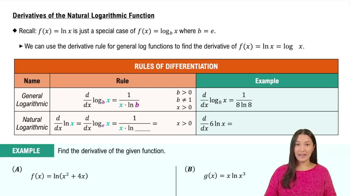
Derivative of the Natural Logarithmic Function

Limit Comparison for Composite Functions

To determine if an expression like x = o(x + ln(x)) holds, one must analyze the limit of the ratio x / (x + ln(x)) as x approaches zero. Understanding how to compare growth rates and evaluate such limits is essential to verify or refute statements involving little-o notation.
Recommended video:
07:45
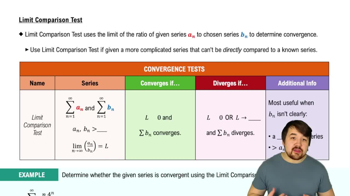
Limit Comparison Test