Ch. 4 - Applications of Derivatives
Hass - Thomas' Calculus 15th Edition
Hass15th EditionThomas' CalculusISBN: 9780137616077Not the one you use?Change textbook
Chapter 4, Problem 4.5.45

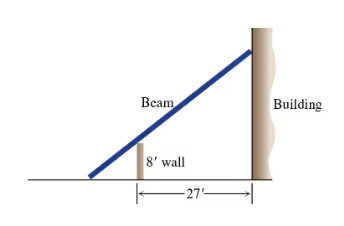
The 8-ft wall shown here stands 27 ft from the building. Find the length of the shortest straight beam that will reach to the side of the building from the ground outside the wall.
beam

Verified step by step guidance
1
Visualize the problem as a right triangle where the beam is the hypotenuse, the wall is one leg, and the distance from the wall to the building is the other leg.
Let the point where the beam touches the wall be (x, 8) and the point where it touches the building be (27, y). The beam forms a right triangle with the ground and the wall.
The length of the beam can be expressed using the Pythagorean theorem: \( L = \sqrt{x^2 + (y - 8)^2} \).
To minimize the length of the beam, we need to express y in terms of x using the similar triangles formed by the beam, wall, and building. The ratio of the sides of the triangles gives us \( \frac{y}{x} = \frac{y - 8}{27} \).
Solve the equation \( \frac{y}{x} = \frac{y - 8}{27} \) for y, substitute back into the expression for L, and find the minimum value of L using calculus by taking the derivative and setting it to zero.

Verified video answer for a similar problem:

This video solution was recommended by our tutors as helpful for the problem above.
Video duration:
11m
Was this helpful?

Key Concepts

Here are the essential concepts you must grasp in order to answer the question correctly.

Pythagorean Theorem

The Pythagorean Theorem states that in a right triangle, the square of the length of the hypotenuse (the side opposite the right angle) is equal to the sum of the squares of the lengths of the other two sides. This theorem is essential for calculating the length of the beam, as it forms a right triangle with the wall and the distance from the wall to the building.
Recommended video:
06:11
Fundamental Theorem of Calculus Part 1

Optimization

Optimization in calculus involves finding the maximum or minimum values of a function. In this problem, we need to minimize the length of the beam, which can be modeled as a function of the height at which it touches the building. Understanding how to set up and solve optimization problems is crucial for finding the shortest beam.
Recommended video:
10:13
Intro to Applied Optimization: Maximizing Area

Related Rates

Related rates are used in calculus to find the rate at which one quantity changes in relation to another. In this scenario, as the height of the beam changes, the length of the beam also changes. Understanding how to relate these rates will help in deriving the function that describes the beam's length in terms of its height.
Recommended video:
04:16
Intro To Related Rates