
Ch. 4 - Applications of Derivatives
Hass - Thomas' Calculus 15th Edition
Hass15th EditionThomas' CalculusISBN: 9780137616077Not the one you use?Change textbook
Chapter 4, Problem 4.1.7

Finding Extrema from Graphs


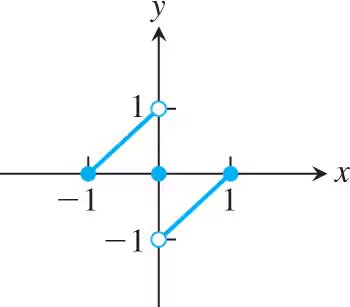
In Exercises 7–10, find the absolute extreme values and where they occur.


Graph showing points and lines indicating local extrema on a coordinate plane with labeled axes.

Verified step by step guidance
1
First, identify the endpoints of the graph. The graph has endpoints at (-1, 1) and (1, -1). These points are important because absolute extrema can occur at endpoints.
Next, observe the graph to identify any local extrema. Local extrema are points where the graph changes direction. In this graph, there is a local maximum at (0, 0) because the graph changes from increasing to decreasing.
Determine the y-values at the endpoints and the local extrema. At (-1, 1), the y-value is 1; at (0, 0), the y-value is 0; and at (1, -1), the y-value is -1.
Compare the y-values to find the absolute maximum and minimum. The absolute maximum is the highest y-value, which is 1 at (-1, 1). The absolute minimum is the lowest y-value, which is -1 at (1, -1).
Conclude that the absolute maximum value is 1 occurring at x = -1, and the absolute minimum value is -1 occurring at x = 1.

Verified video answer for a similar problem:

This video solution was recommended by our tutors as helpful for the problem above.
Video duration:
3m
Was this helpful?

Key Concepts

Here are the essential concepts you must grasp in order to answer the question correctly.

Absolute Extrema

Absolute extrema refer to the highest or lowest points on a graph over a given interval. The absolute maximum is the highest point, while the absolute minimum is the lowest. These points can occur at critical points or endpoints of the interval. Identifying these points involves evaluating the function at critical points and endpoints to determine the largest and smallest values.
Recommended video:
05:58
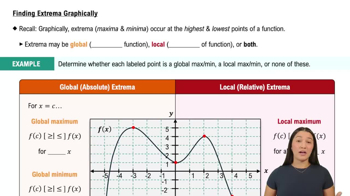
Finding Extrema Graphically

Critical Points

Critical points are where the derivative of a function is zero or undefined, indicating potential local maxima, minima, or points of inflection. To find these points, take the derivative of the function and solve for where it equals zero or is undefined. These points are essential in determining where the function's slope changes, which helps in identifying extrema.
Recommended video:
04:50
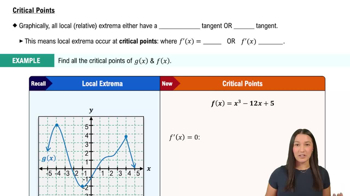
Critical Points

Graph Analysis

Graph analysis involves examining a graph to identify key features such as intercepts, slopes, and extrema. By analyzing the graph, one can visually determine where the function reaches its highest or lowest values. This process includes observing the behavior of the graph at endpoints and critical points, which is crucial for finding absolute extrema.
Recommended video:
06:15
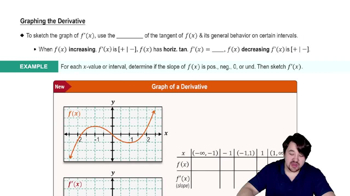
Graphing The Derivative
Related Practice
Textbook Question

Motion with constant acceleration The standard equation for the position s of a body moving with a constant acceleration a along a coordinate line is s = (a/2)t² + v₀t + s₀, where v₀ and s₀ are the body’s velocity and position at time t = 0. Derive this equation by solving the initial value problem

Differential equation: d²s/dt² = a

Initial conditions: ds/dt = v₀ and s = s₀ when t=0.

Textbook Question

Checking the Mean Value Theorem


Find the value or values of c that satisfy the equation (f(b) − f(a)) / (b − a) = f′(c) in the conclusion of the Mean Value Theorem for the functions and intervals in Exercises 1–6.


f(x) =√(x − 1), [1, 3]

Textbook Question

Applications


A marathoner ran the 26.2-mi New York City Marathon in 2.2 hours. Show that at least twice the marathoner was running at exactly 11 mph, assuming the initial and final speeds are zero.

Textbook Question

The 8-ft wall shown here stands 27 ft from the building. Find the length of the shortest straight beam that will reach to the side of the building from the ground outside the wall.

Textbook Question

Solve the initial value problems in Exercises 71–90.

y⁽⁴⁾ = −sin t + cos t;

y′′′(0) =7, y′′(0) = y′(0) = −1, y(0) = 0

Textbook Question

Finding Indefinite Integrals


In Exercises 17–56, find the most general antiderivative or indefinite integral. You may need to try a solution and then adjust your guess. Check your answers by differentiation.


∫csc θ/(csc θ − sin θ) dθ