
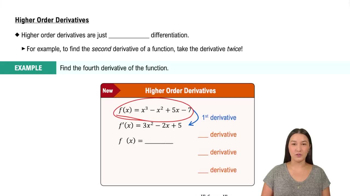
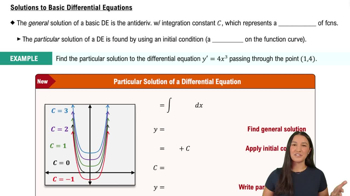
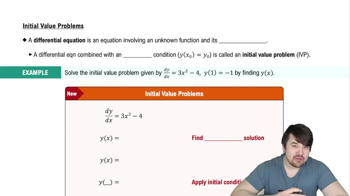
Each of Exercises 67–88 gives the first derivative of a continuous function y=f(x). Find y'' and then use Steps 2–4 of the graphing procedure described in this section to sketch the general shape of the graph of f.
71. y' = x(x² - 12)
Verified step by step guidance
Each of Exercises 67–88 gives the first derivative of a continuous function y=f(x). Find y'' and then use Steps 2–4 of the graphing procedure described in this section to sketch the general shape of the graph of f.
71. y' = x(x² - 12)
Finding Extrema from Graphs
In Exercises 1–6, determine from the graph whether the function has any absolute extreme values on [a, b]. Then explain how your answer is consistent with Theorem 1.
Root Finding
2. Use Newton's method to estimate the one real solution of x^3 +3x + 1 = 0. Start with x_0 = 0 and then find x_2.
Each of Exercises 67–88 gives the first derivative of a continuous function y=f(x). Find y'' and then use Steps 2–4 of the graphing procedure described in this section to sketch the general shape of the graph of f.
82. y' = sin t, for 0 ≤ t ≤ 2π
109. Suppose the derivative of the function y = f(x) is
y'=(x-1)^2(x-2).
At what points, if any, does the graph of f have a local minimum, local maximum, or
point of inflection? (Hint: Draw the sign pattern for y'.)
Finding Indefinite Integrals
In Exercises 17–56, find the most general antiderivative or indefinite integral. You may need to try a solution and then adjust your guess. Check your answers by differentiation.
∫(1 − cot²x) dx