
Ch. 4 - Applications of Derivatives
Hass - Thomas' Calculus 15th Edition
Hass15th EditionThomas' CalculusISBN: 9780137616077Not the one you use?Change textbook
Chapter 4, Problem 4.3.50a

Identifying Extrema


In Exercises 41–52:


a. Identify the function’s local extreme values in the given domain, and say where they occur.


f(x) = √(x² − 2x − 3), 3 ≤ x < ∞

Verified step by step guidance
1
Step 1: Begin by understanding the function f(x) = √(x² − 2x − 3). This is a square root function, and we need to ensure the expression inside the square root is non-negative for the function to be defined.
Step 2: Set the expression inside the square root greater than or equal to zero: x² − 2x − 3 ≥ 0. Solve this inequality to find the domain where the function is defined.
Step 3: Factor the quadratic expression: x² − 2x − 3 = (x - 3)(x + 1). Use this factorization to solve the inequality (x - 3)(x + 1) ≥ 0. Determine the intervals where the product is non-negative.
Step 4: Analyze the critical points and endpoints within the domain 3 ≤ x < ∞. Critical points occur where the derivative is zero or undefined. Find the derivative of f(x) and solve for x where f'(x) = 0 or is undefined.
Step 5: Evaluate the function at the critical points and endpoints to identify local extrema. Compare the values to determine the local maximum or minimum values within the given domain.

Verified video answer for a similar problem:

This video solution was recommended by our tutors as helpful for the problem above.
Video duration:
3m
Was this helpful?

Key Concepts

Here are the essential concepts you must grasp in order to answer the question correctly.

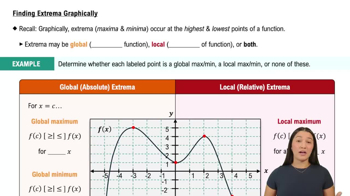
Local Extrema

Local extrema refer to the points in a function where it reaches a local maximum or minimum value. These points occur where the derivative of the function is zero or undefined, indicating a change in the direction of the curve. Identifying local extrema involves finding these critical points and using tests like the first or second derivative test to determine their nature.
Recommended video:
05:58
Finding Extrema Graphically

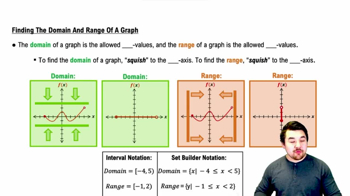
Domain of a Function

The domain of a function is the set of all possible input values (x-values) for which the function is defined. In this problem, the domain is specified as 3 ≤ x < ∞, meaning we only consider x-values starting from 3 and extending to infinity. Understanding the domain is crucial for correctly identifying where extrema can occur within the given constraints.
Recommended video:
5:10
Finding the Domain and Range of a Graph

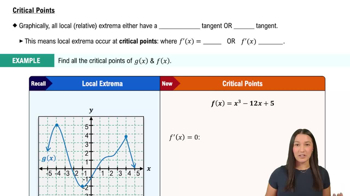
Derivative and Critical Points

The derivative of a function provides the rate of change of the function with respect to its variable. Critical points occur where the derivative is zero or undefined, indicating potential local maxima or minima. To find these points, differentiate the function and solve for x where the derivative equals zero or does not exist, considering the given domain.
Recommended video:
04:50
Critical Points