Ch. 4 - Applications of Derivatives
Hass - Thomas' Calculus 15th Edition
Hass15th EditionThomas' CalculusISBN: 9780137616077Not the one you use?Change textbook
Chapter 4, Problem 4.7.64a

Checking Antiderivative Formulas


Right, or wrong? Say which for each formula and give a brief reason for each answer.


∫tanθ sec²θ dθ = sec³θ / 3 + C

Verified step by step guidance
1
Identify the integral to be checked: \(\int \tan\theta \sec^{2}\theta \, d\theta\).
Recall the derivatives of common trigonometric functions: for example, \(\frac{d}{d\theta}(\sec\theta) = \sec\theta \tan\theta\) and \(\frac{d}{d\theta}(\sec^{3}\theta) = 3 \sec^{2}\theta \cdot \sec\theta \tan\theta = 3 \sec^{3}\theta \tan\theta\).
Compare the integrand \(\tan\theta \sec^{2}\theta\) with the derivative of \(\sec^{3}\theta\): since \(\frac{d}{d\theta}(\sec^{3}\theta) = 3 \sec^{3}\theta \tan\theta\), the integrand is \(\frac{1}{3}\) of this derivative.
Therefore, the integral \(\int \tan\theta \sec^{2}\theta \, d\theta\) should be \(\frac{1}{3} \sec^{3}\theta + C\), matching the given formula \(\frac{\sec^{3}\theta}{3} + C\).
Conclude that the formula is correct because the derivative of the proposed antiderivative matches the integrand.

Verified video answer for a similar problem:

This video solution was recommended by our tutors as helpful for the problem above.
Video duration:
3m
Was this helpful?

Key Concepts

Here are the essential concepts you must grasp in order to answer the question correctly.

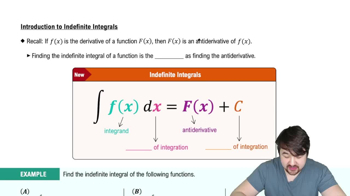
Antiderivatives and Indefinite Integrals

An antiderivative of a function is another function whose derivative equals the original function. Indefinite integrals represent the family of all antiderivatives and include a constant of integration, C. Understanding how to find antiderivatives is essential for verifying integral formulas.
Recommended video:
05:04
Introduction to Indefinite Integrals

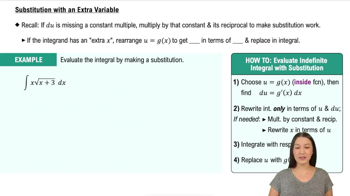
Integration by Substitution

Integration by substitution simplifies integrals by changing variables to make the integral easier to solve. It often involves identifying a part of the integrand as a derivative of another function. Recognizing substitution opportunities helps verify or find antiderivatives involving composite functions.
Recommended video:
04:27
Substitution With an Extra Variable

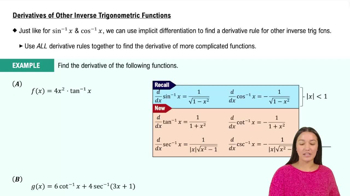
Derivatives of Trigonometric Functions

Knowing the derivatives of trigonometric functions like tan(θ) and sec(θ) is crucial for checking antiderivatives. For example, the derivative of sec(θ) is sec(θ)tan(θ), and the derivative of sec³(θ) involves the chain rule. This knowledge allows one to differentiate the proposed antiderivative to confirm correctness.
Recommended video:
06:35
Derivatives of Other Inverse Trigonometric Functions