
Ch. 4 - Applications of Derivatives
Hass - Thomas' Calculus 15th Edition
Hass15th EditionThomas' CalculusISBN: 9780137616077Not the one you use?Change textbook
Chapter 4, Problem 4.7.39

Finding Indefinite Integrals


In Exercises 17–56, find the most general antiderivative or indefinite integral. You may need to try a solution and then adjust your guess. Check your answers by differentiation.


∫(−3csc²x)dx

Verified step by step guidance
1
Recognize that the integral is of the form \(\int -3 \csc^{2}x \, dx\), where \(-3\) is a constant multiplier and \(\csc^{2}x\) is a standard trigonometric function whose integral is known.
Recall the basic integral formula: \(\int \csc^{2}x \, dx = -\cot x + C\), where \(C\) is the constant of integration.
Use the constant multiple rule for integrals, which allows you to factor out constants: \(\int -3 \csc^{2}x \, dx = -3 \int \csc^{2}x \, dx\).
Substitute the known integral result into the expression: \(-3 \int \csc^{2}x \, dx = -3 (-\cot x + C) = 3 \cot x + C'\), where \(C'\) is a new constant of integration.
Verify your result by differentiating \(3 \cot x + C'\) and confirming that it equals the original integrand \(-3 \csc^{2}x\).

Verified video answer for a similar problem:

This video solution was recommended by our tutors as helpful for the problem above.
Video duration:
59s
Was this helpful?

Key Concepts

Here are the essential concepts you must grasp in order to answer the question correctly.

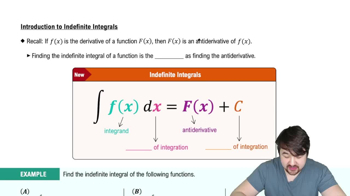
Indefinite Integral

An indefinite integral represents the most general antiderivative of a function, expressed with a constant of integration (C). It reverses differentiation and includes all possible functions whose derivative matches the integrand.
Recommended video:
05:04
Introduction to Indefinite Integrals

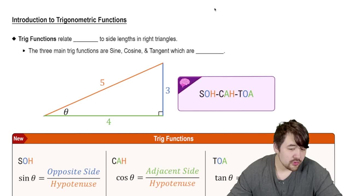
Integration of Trigonometric Functions

Integrating trigonometric functions like csc²x involves knowing standard integral formulas, such as ∫csc²x dx = -cot x + C. Recognizing these forms simplifies finding antiderivatives.
Recommended video:
6:04
Introduction to Trigonometric Functions

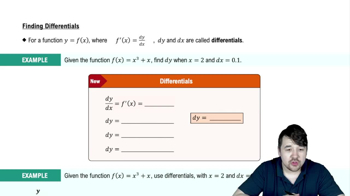
Verification by Differentiation

After finding an indefinite integral, differentiating the result should return the original integrand. This step confirms the correctness of the antiderivative and helps identify any errors.
Recommended video:
05:53
Finding Differentials
Related Practice
Textbook Question

Identify the inflection points and local maxima and minima of the functions graphed in Exercises 1–8. Identify the open intervals on which the functions are differentiable and the graphs are concave up and concave down.

8. y = 2cosx - √2x, -π≤x≤3π/2

Textbook Question

Each of Exercises 67–88 gives the first derivative of a continuous function y=f(x). Find y'' and then use Steps 2–4 of the graphing procedure described in this section to sketch the general shape of the graph of f.

85. y' = x^(-2/3) (x - 1)

Textbook Question

Finding Indefinite Integrals


In Exercises 17–56, find the most general antiderivative or indefinite integral. You may need to try a solution and then adjust your guess. Check your answers by differentiation.


∫(1/x² − x² − 1/3) dx

Textbook Question

Finding Indefinite Integrals


In Exercises 17–56, find the most general antiderivative or indefinite integral. You may need to try a solution and then adjust your guess. Check your answers by differentiation.


∫(4secx tanx − 2 sec²x)dx

Textbook Question

Finding Functions from Derivatives


In Exercises 37–40, find the function with the given derivative whose graph passes through the point P.


f'(x) = 2x − 1, P(0,0)

Textbook Question

10. Catching rainwater A 1125 ft^3 open-top rectangular tank with a square base x ft on a side and y ft deep is to be built with its top flush with the ground to catch runoff water. The costs associated with the tank involve not only the material from which the tank is made but also an excavation charge proportional to the product xy.

a. If the total cost is c=5(x^2+4xy) + 10xy, what values of x and y will minimize it?

b. Give a possible scenario for the cost function in part (a).