Ch. 4 - Applications of Derivatives
Hass - Thomas' Calculus 15th Edition
Hass15th EditionThomas' CalculusISBN: 9780137616077Not the one you use?Change textbook
Chapter 4, Problem 4.1.45

Finding Critical Points


In Exercises 41–50, determine all critical points and all domain endpoints for each function.


y = x² + 2/x

Verified step by step guidance
1
First, identify the domain of the function y = x² + 2/x. Since the function includes a term 2/x, x cannot be zero. Therefore, the domain is all real numbers except x = 0.
To find the critical points, we need to find the derivative of the function y = x² + 2/x. Use the power rule and the quotient rule to differentiate: y' = d/dx (x²) + d/dx (2/x).
Calculate the derivative: y' = 2x - 2/x². This involves differentiating x² to get 2x and using the power rule on 2/x to get -2/x².
Set the derivative equal to zero to find critical points: 2x - 2/x² = 0. Solve this equation for x to find the values where the slope of the tangent is zero.
Additionally, check the endpoints of the domain. Since the domain is all real numbers except x = 0, consider the behavior of the function as x approaches zero from both the positive and negative sides to understand the behavior at the domain boundaries.

Verified video answer for a similar problem:

This video solution was recommended by our tutors as helpful for the problem above.
Video duration:
4m

Key Concepts

Here are the essential concepts you must grasp in order to answer the question correctly.

Critical Points

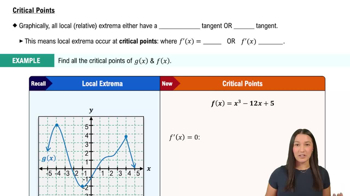
Critical points of a function occur where its derivative is zero or undefined. These points are important because they can indicate local maxima, minima, or points of inflection. To find them, take the derivative of the function and solve for the values of x where the derivative equals zero or does not exist.
Recommended video:
04:50
Critical Points

Derivative

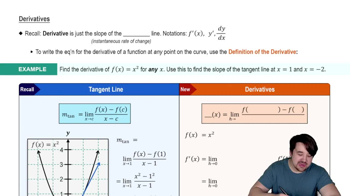
The derivative of a function represents the rate of change of the function with respect to its variable. It is a fundamental tool in calculus used to find slopes of tangent lines, velocities, and other rates of change. For the function y = x² + 2/x, the derivative is found using the power rule and the quotient rule.
Recommended video:

Domain of a Function

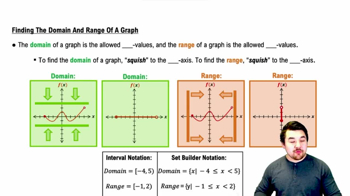
The domain of a function is the set of all possible input values (x-values) for which the function is defined. For rational functions like y = x² + 2/x, the domain excludes values that make the denominator zero. Identifying the domain is crucial for understanding where critical points and endpoints can occur.
Recommended video:
Guided course
5:10
Finding the Domain and Range of a Graph
Related Practice
Textbook Question

Finding Extreme Values

In Exercises 1–10, find the extreme values (absolute and local) of the function over its natural domain, and where they occur.


y = 𝓍³ ― 2𝓍 + 4

Textbook Question

Roots (Zeros)


Show that the functions in Exercises 19–26 have exactly one zero in the given interval.


f(x) = x³ + 4x² + 7, (−∞, 0)

Textbook Question

Applications


Liftoff from Earth A rocket lifts off the surface of Earth with a constant acceleration of 20 m/sec². How fast will the rocket be going 1 min later?

Textbook Question

In Exercises 9–66, graph the function using appropriate methods from the graphing procedures presented just before Example 9, identifying the coordinates of any local extreme points and inflection points. Then find coordinates of absolute extreme points, if any.

53. y = x * √(8 - x²)

Textbook Question

54. Fermat’s principle in optics Light from a source A is reflected by a plane mirror to a receiver at point B, as shown in the accompanying figure. Show that for the light to obey Fermat’s principle, the angle of incidence must equal the angle of reflection, both measured from the line normal to the reflecting surface. (This result can also be derived without calculus. There is a purely geometric argument, which you may prefer.)

1
views
Textbook Question

Identifying Extrema


In Exercises 15–18:


a. Find the open intervals on which the function is increasing and those on which it is decreasing.


b. Identify the function’s local and absolute extreme values, if any, saying where they occur.