
Ch. 4 - Applications of Derivatives
Hass - Thomas' Calculus 15th Edition
Hass15th EditionThomas' CalculusISBN: 9780137616077Not the one you use?Change textbook
Chapter 4, Problem 4.14

Find values of a and b such that the function


Ζ’(𝓍) = (a𝓍 + b) / 𝓍² ―1)


has a local extreme value of 1 at 𝓍 = 3. Is this extreme value a local maximum or a local minimum? Give reasons for your answer.

Verified step by step guidance
1
To find the local extreme value, we first need to find the derivative of the function Ζ’(𝓍) = (a𝓍 + b) / (𝓍² - 1). Use the quotient rule for differentiation, which states that if you have a function g(𝓍) = u(𝓍)/v(𝓍), then g'(𝓍) = (u'(𝓍)v(𝓍) - u(𝓍)v'(𝓍)) / (v(𝓍)Β²).
Apply the quotient rule to Ζ’(𝓍) = (a𝓍 + b) / (𝓍² - 1). Here, u(𝓍) = a𝓍 + b and v(𝓍) = 𝓍² - 1. Calculate the derivatives: u'(𝓍) = a and v'(𝓍) = 2𝓍.
Substitute these derivatives into the quotient rule formula to find Ζ’'(𝓍). Simplify the expression to get the derivative in terms of 𝓍, a, and b.
Set Ζ’'(𝓍) = 0 to find the critical points. Substitute 𝓍 = 3 into the derivative equation and solve for a and b, given that the function has a local extreme value at this point.
To determine whether the extreme value is a local maximum or minimum, use the second derivative test. Find Ζ’''(𝓍) by differentiating Ζ’'(𝓍) again. Evaluate Ζ’''(3) and use the sign of this value to conclude whether the extreme value is a maximum (if Ζ’''(3) < 0) or a minimum (if Ζ’''(3) > 0).

Verified video answer for a similar problem:

This video solution was recommended by our tutors as helpful for the problem above.
Video duration:
5m
Was this helpful?

Key Concepts

Here are the essential concepts you must grasp in order to answer the question correctly.

Derivative and Critical Points

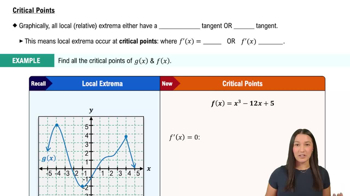
The derivative of a function provides information about its rate of change. To find local extreme values, we identify critical points where the derivative is zero or undefined. These points are potential locations for local maxima or minima, as they indicate where the function's slope changes direction.
Recommended video:
04:50
Critical Points

Second Derivative Test

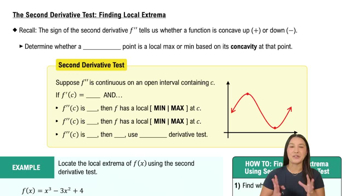
The second derivative test helps determine the nature of a critical point. If the second derivative at a critical point is positive, the function has a local minimum there; if negative, a local maximum. This test provides insight into the concavity of the function at the critical point, indicating whether the function curves upwards or downwards.
Recommended video:
06:02
The Second Derivative Test: Finding Local Extrema

Function Evaluation

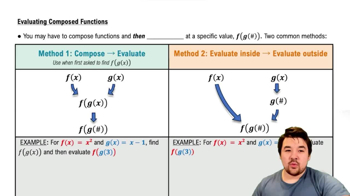
Evaluating the function at specific points is crucial for verifying extreme values. By substituting the given x-value into the function, we can confirm the function's value at that point. This step ensures that the calculated extreme value matches the conditions specified in the problem, such as having a value of 1 at x = 3.
Recommended video:
4:26
Evaluating Composed Functions
Related Practice
Textbook Question

22. A window is in the form of a rectangle surmounted by a semicircle. The rectangle is of clear glass, whereas the semicircle is of tinted glass that transmits only half as much light per unit area as clear glass does. The total perimeter is fixed. Find the proportions of the window that will admit the most light. Neglect the thickness of the frame.

" style="" width="180">

Textbook Question

Checking the Mean Value Theorem


Which of the functions in Exercises 7–12 satisfy the hypotheses of the Mean Value Theorem on the given interval, and which do not? Give reasons for your answers.


f(x) = x⁴ᐟ⁡, [0, 1]

Textbook Question

Initial Value Problems


Solve the initial value problems in Exercises 71–90.


dy/dx = 3x⁻²ᐟ³, y(βˆ’1) = βˆ’5

Textbook Question

Theory and Examples


[Technology Exercise] Graph the functions in Exercises 63–66. Then find the extreme values of the function on the interval and say where they occur.


h(x) = |x + 2| βˆ’ |x βˆ’ 3|, βˆ’βˆž < x < ∞

Textbook Question

Identify the inflection points and local maxima and minima of the functions graphed in Exercises 1–8. Identify the open intervals on which the functions are differentiable and the graphs are concave up and concave down.

4. y=9/14x^(1/3)(x^2-7)

Textbook Question

Finding Indefinite Integrals


In Exercises 17–56, find the most general antiderivative or indefinite integral. You may need to try a solution and then adjust your guess. Check your answers by differentiation.


∫(1 + tan²θ)dθ (Hint:1 + tan²θ = sec²θ)