Ch. 4 - Applications of Derivatives
Hass - Thomas' Calculus 15th Edition
Hass15th EditionThomas' CalculusISBN: 9780137616077Not the one you use?Change textbook
Chapter 4, Problem 4.5.22

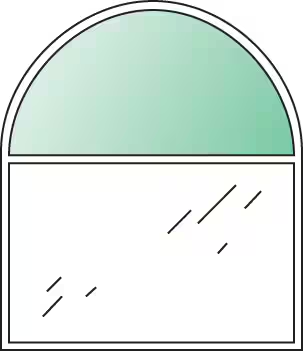
22. A window is in the form of a rectangle surmounted by a semicircle. The rectangle is of clear glass, whereas the semicircle is of tinted glass that transmits only half as much light per unit area as clear glass does. The total perimeter is fixed. Find the proportions of the window that will admit the most light. Neglect the thickness of the frame.
<IMAGE>

Verified step by step guidance
1
Step 1: Define the variables. Let the width of the rectangular part of the window be 'w' and the height of the rectangular part be 'h'. The radius of the semicircle will be 'r', which is equal to half the width of the rectangle (r = w/2).
Step 2: Express the total perimeter constraint. The perimeter consists of the two heights of the rectangle, the width of the rectangle, and the circumference of the semicircle. The total perimeter is given by: P = 2h + w + πr, where r = w/2.
Step 3: Write the light transmission function. The light admitted by the window is the sum of the light transmitted by the rectangle and the semicircle. The rectangle transmits light proportional to its area (A_rectangle = w * h), while the semicircle transmits half as much light per unit area (A_semicircle = (1/2) * (1/2)πr²). The total light transmission is: L = w * h + (1/4)πr².
Step 4: Substitute the perimeter constraint into the light transmission function. Use the relationship from Step 2 to express 'h' in terms of 'w' and 'P', then substitute this into the light transmission function to reduce the number of variables.
Step 5: Maximize the light transmission function. Use calculus to find the critical points of the function L with respect to 'w'. Take the derivative of L with respect to 'w', set it equal to zero, and solve for 'w'. Verify that the solution gives a maximum by checking the second derivative or using other methods.

Verified video answer for a similar problem:

This video solution was recommended by our tutors as helpful for the problem above.
Video duration:
8m
Was this helpful?

Key Concepts

Here are the essential concepts you must grasp in order to answer the question correctly.

Perimeter Constraint

In this problem, the total perimeter of the window is fixed, which means that the sum of the lengths of all sides must remain constant. This constraint is crucial for setting up the equations needed to optimize the dimensions of the window. Understanding how to express the perimeter in terms of the window's dimensions will allow us to derive relationships between the height and width of the rectangle and the radius of the semicircle.
Recommended video:
10:13
Intro to Applied Optimization: Maximizing Area

Area Optimization

The goal of the problem is to maximize the amount of light admitted through the window, which involves optimizing the area of the rectangle and the semicircle. The area of the rectangle is straightforward, while the area of the semicircle requires knowledge of the formula for the area of a circle. By combining these areas and applying optimization techniques, such as taking derivatives, we can find the dimensions that yield the maximum light transmission.
Recommended video:
10:13
Intro to Applied Optimization: Maximizing Area

Light Transmission Properties

The problem specifies that the semicircle is made of tinted glass, which transmits only half as much light per unit area as the clear glass of the rectangle. This difference in light transmission must be factored into the optimization process, as it affects the effective area contributing to the total light admitted. Understanding how to incorporate these varying transmission rates into the area calculations is essential for accurately determining the optimal proportions of the window.
Recommended video:
06:21
Properties of Functions