Ch. 3 - Derivatives
Hass - Thomas' Calculus 15th Edition
Hass15th EditionThomas' CalculusISBN: 9780137616077Not the one you use?Change textbook
Chapter 3, Problem 3.9.48b

Tolerance


b. About how accurately must the tank’s exterior diameter be measured to calculate the amount of paint it will take to paint the side of the tank to within 5% of the true amount?

Verified step by step guidance
1
Identify the formula for the surface area of the side of a cylindrical tank, which is given by \( A = 2\pi rh \), where \( r \) is the radius and \( h \) is the height of the cylinder.
Recognize that the diameter \( D \) is related to the radius by \( D = 2r \). Therefore, the surface area can also be expressed in terms of the diameter as \( A = \pi Dh \).
To find the tolerance in the diameter measurement, we need to determine how a small change in \( D \) affects the surface area \( A \). This involves calculating the derivative \( \frac{dA}{dD} \), which represents the rate of change of the area with respect to the diameter.
Calculate the derivative \( \frac{dA}{dD} = \pi h \). This tells us how much the area changes for a small change in the diameter.
Set up the inequality \( \left| \frac{\Delta A}{A} \right| \leq 0.05 \) to ensure the change in area is within 5% of the true area. Substitute \( \Delta A = \pi h \Delta D \) and solve for \( \Delta D \) to find the required accuracy in the diameter measurement.

Verified video answer for a similar problem:

This video solution was recommended by our tutors as helpful for the problem above.
Video duration:
3m
Was this helpful?

Key Concepts

Here are the essential concepts you must grasp in order to answer the question correctly.

Differential Approximation

Differential approximation is a method used in calculus to estimate how a small change in one variable affects a function's output. It involves using the derivative of the function to approximate the change in the function's value. This concept is crucial for understanding how small errors in measurement can impact the calculated amount of paint needed for the tank.
Recommended video:
05:53
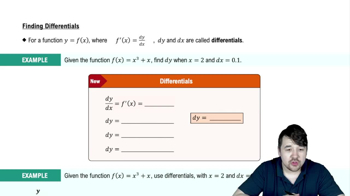
Finding Differentials

Surface Area of a Cylinder

The surface area of a cylinder, particularly the lateral surface area, is calculated using the formula 2πrh, where r is the radius and h is the height. Understanding this formula is essential for determining how changes in the tank's diameter affect the surface area, and consequently, the amount of paint required.
Recommended video:
09:07
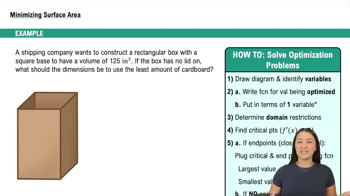
Example 1: Minimizing Surface Area

Percentage Error

Percentage error quantifies the accuracy of a measurement by comparing the error to the true value, expressed as a percentage. In this context, it helps determine how precise the diameter measurement must be to ensure the paint calculation is within 5% of the true amount. This concept is vital for assessing the impact of measurement inaccuracies on the final result.
Recommended video:
04:57
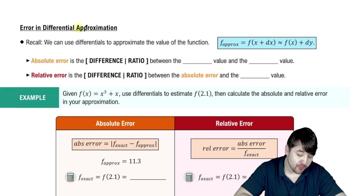
Determining Error and Relative Error