Ch. 3 - Derivatives
Hass - Thomas' Calculus 15th Edition
Hass15th EditionThomas' CalculusISBN: 9780137616077Not the one you use?Change textbook
Chapter 3, Problem 3.96b

Right circular cone The lateral surface area S of a right circular cone is related to the base radius r and height h by the equation
______
S = πrr² + .


b. How is dS/dt related to dh/dt if r is constant?

Verified step by step guidance
1
Start with the given formula for the lateral surface area of a right circular cone: \( S = \pi r \sqrt{r^2 + h^2} \).
Since the radius \( r \) is constant, differentiate both sides of the equation with respect to time \( t \) to find \( \frac{dS}{dt} \).
Apply the chain rule to differentiate the right side: \( \frac{dS}{dt} = \pi r \cdot \frac{d}{dt}(\sqrt{r^2 + h^2}) \).
Differentiate \( \sqrt{r^2 + h^2} \) with respect to \( t \) using the chain rule: \( \frac{d}{dt}(\sqrt{r^2 + h^2}) = \frac{1}{2\sqrt{r^2 + h^2}} \cdot 2h \cdot \frac{dh}{dt} \).
Substitute the derivative back into the expression for \( \frac{dS}{dt} \): \( \frac{dS}{dt} = \pi r \cdot \frac{h}{\sqrt{r^2 + h^2}} \cdot \frac{dh}{dt} \). This shows how \( \frac{dS}{dt} \) is related to \( \frac{dh}{dt} \) when \( r \) is constant.

Verified video answer for a similar problem:

This video solution was recommended by our tutors as helpful for the problem above.
Video duration:
3m
Was this helpful?

Key Concepts

Here are the essential concepts you must grasp in order to answer the question correctly.

Lateral Surface Area of a Cone

The lateral surface area of a right circular cone is the area of the cone's curved surface, excluding the base. It is calculated using the formula S = πr√(r² + h²), where r is the radius of the base and h is the height of the cone. Understanding this formula is essential for analyzing how changes in height or radius affect the surface area.
Recommended video:
09:07
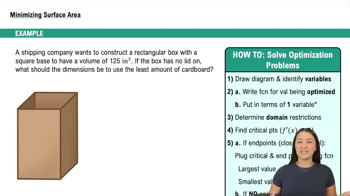
Example 1: Minimizing Surface Area

Related Rates

Related rates involve finding the rate at which one quantity changes in relation to another. In this context, we are interested in how the rate of change of the lateral surface area (dS/dt) is related to the rate of change of height (dh/dt) while keeping the radius constant. This concept is fundamental in calculus for solving problems involving dynamic systems.
Recommended video:
04:16
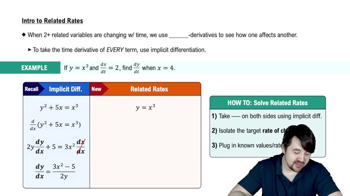
Intro To Related Rates

Differentiation

Differentiation is a key concept in calculus that involves finding the derivative of a function, which represents the rate of change of that function with respect to a variable. In this problem, we will differentiate the lateral surface area formula with respect to time to establish the relationship between dS/dt and dh/dt. Mastery of differentiation techniques is crucial for solving related rates problems.
Recommended video:
05:53
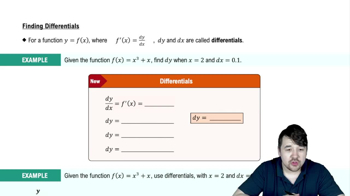
Finding Differentials