
Ch. 3 - Derivatives
Hass - Thomas' Calculus 15th Edition
Hass15th EditionThomas' CalculusISBN: 9780137616077Not the one you use?Change textbook
Chapter 3, Problem 3.2.51c

Theory and Examples


In Exercises 51–54,


c. For what values of x, if any, is f' positive? Zero? Negative?


y = −x²

Verified step by step guidance
1
First, find the derivative of the function y = -x². The derivative, denoted as f', represents the rate of change of the function. Use the power rule for differentiation, which states that the derivative of x^n is n*x^(n-1).
Apply the power rule to y = -x². The derivative of -x² is f'(x) = -2x. This is because the derivative of x² is 2x, and the negative sign remains as a constant factor.
To determine where f' is positive, set the derivative -2x > 0 and solve for x. This inequality will tell you the range of x values where the function is increasing.
To find where f' is zero, set the derivative -2x = 0 and solve for x. This will give you the x value where the function has a horizontal tangent, indicating a potential maximum or minimum point.
To determine where f' is negative, set the derivative -2x < 0 and solve for x. This inequality will tell you the range of x values where the function is decreasing.

Verified video answer for a similar problem:

This video solution was recommended by our tutors as helpful for the problem above.
Video duration:
2m
Was this helpful?

Key Concepts

Here are the essential concepts you must grasp in order to answer the question correctly.

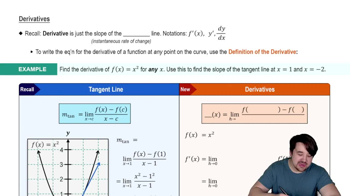
Derivative

The derivative of a function, denoted as f', represents the rate of change of the function with respect to its variable. It provides information about the slope of the tangent line to the curve at any given point. For the function y = -x², the derivative helps determine where the function is increasing, decreasing, or has a horizontal tangent.
Recommended video:
05:44
Derivatives

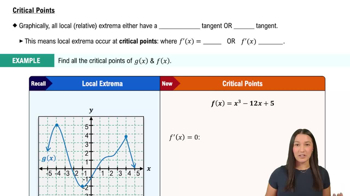
Critical Points

Critical points occur where the derivative of a function is zero or undefined. These points are important for identifying where a function changes from increasing to decreasing or vice versa. For y = -x², finding the critical points involves setting the derivative equal to zero and solving for x, which helps in analyzing the behavior of the function.
Recommended video:
04:50
Critical Points

Sign of the Derivative

The sign of the derivative indicates whether a function is increasing or decreasing. If f' is positive, the function is increasing; if f' is negative, the function is decreasing; and if f' is zero, the function has a horizontal tangent. Analyzing the sign of the derivative for y = -x² helps determine the intervals where the function is increasing, decreasing, or constant.
Recommended video:
05:44
Derivatives
Related Practice
Textbook Question

Analyzing Motion Using Graphs


[Technology Exercise] Exercises 31–34 give the position function s = f(t) of an object moving along the s-axis as a function of time t. Graph f together with the velocity function v(t) = ds/dt = f'(t) and the acceleration function a(t) = d²s/dt² = f''(t). Comment on the object’s behavior in relation to the signs and values of v and a. Include in your commentary such topics as the following:


c. When does it change direction?


s = t² - 3t + 2, 0 ≤ t ≤ 5

Textbook Question

Theory and Examples


In Exercises 51–54,


d. Over what intervals of x-values, if any, does the function y = f(x) increase as x increases? Decrease as x increases? How is this related to what you found in part (c)? (We will say more about this relationship in Section 4.3.)


y = −1/x

Textbook Question

Right circular cylinder The total surface area S of a right circular cylinder is related to the base radius r and height h by the equation S = 2πr² + 2πrh.


d. How is dr/dt related to dh/dt if S is constant?

Textbook Question

The folium of Descartes (See Figure 3.27)


c. Find the coordinates of the point A in Figure 3.29 where the folium has a vertical tangent line.


Textbook Question

By computing the first few derivatives and looking for a pattern, find the following derivatives.


c. d⁷³/dx⁷³ (x sin x)

Textbook Question

Theory and Examples


In Exercises 51–54,


d. Over what intervals of x-values, if any, does the function y = f(x) increase as x increases? Decrease as x increases? How is this related to what you found in part (c)? (We will say more about this relationship in Section 4.3.)


y = x³/3