
Ch. 3 - Derivatives
Hass - Thomas' Calculus 15th Edition
Hass15th EditionThomas' CalculusISBN: 9780137616077Not the one you use?Change textbook
Chapter 3, Problem 3.7.46c

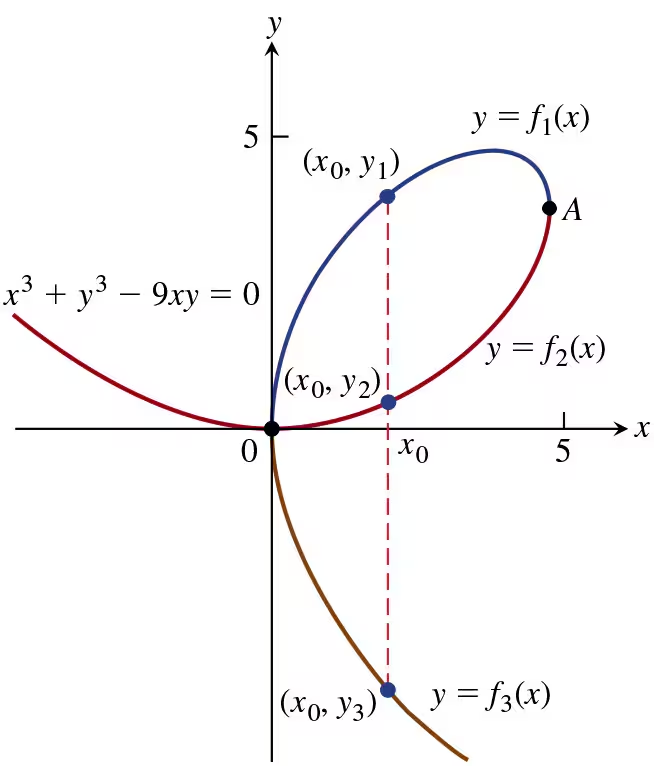
The folium of Descartes (See Figure 3.27)


c. Find the coordinates of the point A in Figure 3.29 where the folium has a vertical tangent line.


Verified step by step guidance
1
The folium of Descartes is given by the equation \(x^3 + y^3 - 9xy = 0\). To find where the curve has a vertical tangent, we need to find where the derivative \(\frac{dy}{dx}\) is undefined.
Implicitly differentiate the equation \(x^3 + y^3 - 9xy = 0\) with respect to \(x\). This involves using the chain rule for \(y^3\) and the product rule for \(-9xy\).
After differentiating, you will get an expression for \(\frac{dy}{dx}\). Set the denominator of this expression to zero to find where the derivative is undefined, indicating a vertical tangent.
Solve the resulting equation for \(x\) and \(y\) to find the coordinates of the point(s) where the tangent is vertical.
Substitute the values of \(x\) and \(y\) back into the original equation to verify that they satisfy the folium of Descartes equation, confirming the point A where the tangent is vertical.

Verified video answer for a similar problem:

This video solution was recommended by our tutors as helpful for the problem above.
Video duration:
7m
Was this helpful?

Key Concepts

Here are the essential concepts you must grasp in order to answer the question correctly.

Vertical Tangent Line

A vertical tangent line occurs at a point on a curve where the slope of the tangent approaches infinity. This typically happens when the derivative of the function is undefined or infinite at that point. In the context of the folium of Descartes, finding the coordinates of point A involves determining where the derivative of the curve is undefined, indicating a vertical tangent.
Recommended video:
05:13
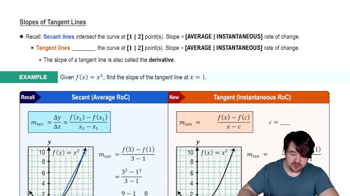
Slopes of Tangent Lines

Implicit Differentiation

Implicit differentiation is a technique used to differentiate equations that define y implicitly in terms of x, rather than explicitly as y = f(x). For the folium of Descartes, which is defined by the equation x³ + y³ - 9xy = 0, implicit differentiation allows us to find dy/dx, the slope of the tangent line, at any point on the curve, including where it is vertical.
Recommended video:
05:14
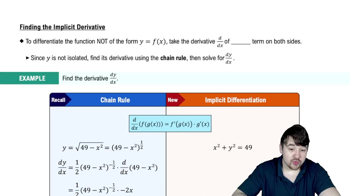
Finding The Implicit Derivative

Folium of Descartes

The folium of Descartes is a specific type of algebraic curve defined by the equation x³ + y³ - 9xy = 0. It has a distinctive shape and features, including points where the tangent lines can be vertical. Understanding the properties of this curve is essential for analyzing its behavior and finding points of interest, such as point A with a vertical tangent.
Related Practice
Textbook Question

Analyzing Motion Using Graphs


[Technology Exercise] Exercises 31–34 give the position function s = f(t) of an object moving along the s-axis as a function of time t. Graph f together with the velocity function v(t) = ds/dt = f'(t) and the acceleration function a(t) = d²s/dt² = f''(t). Comment on the object’s behavior in relation to the signs and values of v and a. Include in your commentary such topics as the following:


c. When does it change direction?


s = t² - 3t + 2, 0 ≤ t ≤ 5

Textbook Question

Theory and Examples


In Exercises 51–54,


c. For what values of x, if any, is f' positive? Zero? Negative?


y = −x²

Textbook Question

Differentiability and Continuity on an Interval


Each figure in Exercises 45–50 shows the graph of a function over a closed interval D. At what domain points does the function appear to be


c. neither continuous nor differentiable?


Give reasons for your answers.


Textbook Question

Theory and Examples


In Exercises 51–54,


d. Over what intervals of x-values, if any, does the function y = f(x) increase as x increases? Decrease as x increases? How is this related to what you found in part (c)? (We will say more about this relationship in Section 4.3.)


y = −1/x

Textbook Question

By computing the first few derivatives and looking for a pattern, find the following derivatives.


c. d⁷³/dx⁷³ (x sin x)

Textbook Question

Theory and Examples


In Exercises 51–54,


d. Over what intervals of x-values, if any, does the function y = f(x) increase as x increases? Decrease as x increases? How is this related to what you found in part (c)? (We will say more about this relationship in Section 4.3.)


y = x³/3