
Ch. 3 - Derivatives
Hass - Thomas' Calculus 15th Edition
Hass15th EditionThomas' CalculusISBN: 9780137616077Not the one you use?Change textbook
Chapter 3, Problem 95a

The total surface area S of a right circular cylinder is related to the base radius r and height h by the equation S = 2πr² + 2πrh.


a. How is dS/dt related to dr/dt if h is constant?

Verified step by step guidance
1
Start by identifying the given equation for the total surface area of the cylinder: S = 2πr² + 2πrh.
Since h is constant, treat h as a constant value when differentiating with respect to time t.
Differentiate the surface area equation S with respect to time t using the chain rule. The derivative of S with respect to t, dS/dt, will involve the derivatives of r with respect to t, dr/dt.
Apply the chain rule: dS/dt = d/dt(2πr²) + d/dt(2πrh).
Calculate each derivative: d/dt(2πr²) = 4πr(dr/dt) and d/dt(2πrh) = 2πh(dr/dt). Combine these to express dS/dt in terms of dr/dt: dS/dt = 4πr(dr/dt) + 2πh(dr/dt).

Verified video answer for a similar problem:

This video solution was recommended by our tutors as helpful for the problem above.
Video duration:
4m
Was this helpful?

Key Concepts

Here are the essential concepts you must grasp in order to answer the question correctly.

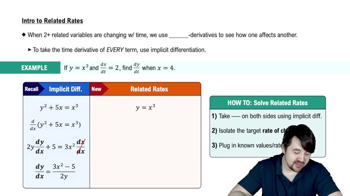
Related Rates

Related rates involve finding the rate at which one quantity changes in relation to another. In this context, we are interested in how the surface area S of a cylinder changes with respect to time as the radius r changes, while keeping the height h constant. This concept is fundamental in calculus for solving problems where multiple variables are interdependent.
Recommended video:
04:16
Intro To Related Rates

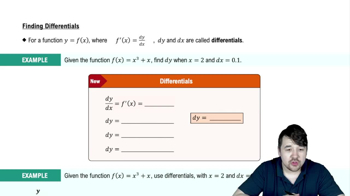
Differentiation

Differentiation is the process of finding the derivative of a function, which represents the rate of change of that function with respect to a variable. In this case, we will differentiate the surface area equation S = 2πr² + 2πrh with respect to time t to find dS/dt. Understanding how to apply differentiation to functions is crucial for analyzing dynamic systems.
Recommended video:
05:53
Finding Differentials

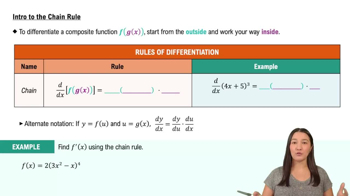
Chain Rule

The chain rule is a fundamental theorem in calculus used to differentiate composite functions. When applying the chain rule to the surface area equation, we will express dS/dt in terms of dr/dt, allowing us to relate the rates of change of the radius and the surface area. This concept is essential for solving related rates problems effectively.
Recommended video:
05:02
Intro to the Chain Rule
Related Practice
Textbook Question

Resistors connected in parallel If two resistors of R₁ and R₂ ohms are connected in parallel in an electric circuit to make an R-ohm resistor, the value of R can be found from the equation


1/R = 1/R₁ + 1/R₂


<IMAGE>


If R₁ is decreasing at the rate of 1ohm/sec and R₂ is increasing at the rate of 0.5 ohm/sec, at what rate is R changing when R₁ = 75 ohms and R₂ = 50 ohms?

Textbook Question

Temperature and the period of a pendulum For oscillations of small amplitude (short swings), we may safely model the relationship between the period T and the length L of a simple pendulum with the equation:


T = 2π√(L/g),


where g is the constant acceleration of gravity at the pendulum’s location. If we measure g in centimeters per second squared, we measure L in centimeters and T in seconds. If the pendulum is made of metal, its length will vary with temperature, either increasing or decreasing at a rate that is roughly proportional to L. In symbols, with u being temperature and k the proportionality constant,


dL/du = kL.


Assuming this to be the case, show that the rate at which the period changes with respect to temperature is kT/2.

Textbook Question

Right circular cone The lateral surface area S of a right circular cone is related to the base radius r and height h by the equation

______

S = πrr² + .


c. How is dS/dt related to dr/dt and dh/dt if neither r nor h is constant?

Textbook Question

The lateral surface area S of a right circular cone is related to the base radius r and height h by the equation S = πr√(r² + h²). 

a. How is dS/dt related to dr/dt if h is constant?

Textbook Question

If x¹/³ + y¹/³ = 4, find d²y/dx² at the point (8, 8).

Textbook Question

Derivative of y = |x| Graph the derivative of f(x) = |x|. Then graph y = (|x| − 0)/(x − 0) = |x|/x. What can you conclude?