Ch. 3 - Derivatives
Hass - Thomas' Calculus 15th Edition
Hass15th EditionThomas' CalculusISBN: 9780137616077Not the one you use?Change textbook
Chapter 3, Problem 91

Temperature and the period of a pendulum For oscillations of small amplitude (short swings), we may safely model the relationship between the period T and the length L of a simple pendulum with the equation:


T = 2π√(L/g),


where g is the constant acceleration of gravity at the pendulum’s location. If we measure g in centimeters per second squared, we measure L in centimeters and T in seconds. If the pendulum is made of metal, its length will vary with temperature, either increasing or decreasing at a rate that is roughly proportional to L. In symbols, with u being temperature and k the proportionality constant,


dL/du = kL.


Assuming this to be the case, show that the rate at which the period changes with respect to temperature is kT/2.

Verified step by step guidance
1
Start by differentiating the given equation for the period of the pendulum, T = 2π√(L/g), with respect to temperature u. This requires using the chain rule since L is a function of u.
Apply the chain rule: dT/du = (dT/dL) * (dL/du). First, find dT/dL by differentiating T = 2π√(L/g) with respect to L. This gives dT/dL = π/√(Lg).
Substitute the expression for dL/du from the problem, which is dL/du = kL, into the chain rule expression. This gives dT/du = (π/√(Lg)) * (kL).
Simplify the expression for dT/du. Notice that L/√L simplifies to √L, so dT/du = πk√(L/g).
Recognize that T = 2π√(L/g) from the original equation. Therefore, dT/du = (k/2) * T, which shows that the rate at which the period changes with respect to temperature is kT/2.

Verified video answer for a similar problem:

This video solution was recommended by our tutors as helpful for the problem above.
Video duration:
4m
Was this helpful?

Key Concepts

Here are the essential concepts you must grasp in order to answer the question correctly.

Differentiation

Differentiation is a fundamental concept in calculus that involves finding the rate at which a function changes at any given point. In this context, it is used to determine how the period T of the pendulum changes with respect to temperature u. By differentiating the equation T = 2π√(L/g) with respect to u, we can find the relationship between the change in period and temperature.
Recommended video:
05:53
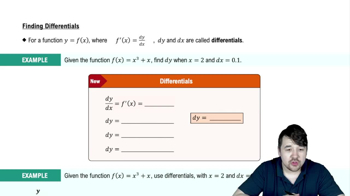
Finding Differentials

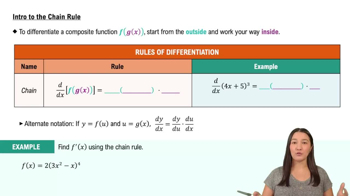
Chain Rule

The chain rule is a technique in calculus used to differentiate composite functions. It is essential here because the period T is a function of the length L, which in turn is a function of temperature u. By applying the chain rule, we can differentiate T with respect to u by first differentiating T with respect to L and then multiplying by the derivative of L with respect to u.
Recommended video:
05:02
Intro to the Chain Rule

Proportionality and Linear Differential Equations

The relationship dL/du = kL indicates that the rate of change of the pendulum's length with respect to temperature is proportional to its current length. This is a first-order linear differential equation, which implies that L changes exponentially with temperature. Understanding this concept helps in deriving the expression for the rate of change of the period T with respect to temperature.
Recommended video:
07:17
Linearization