
Ch. 3 - Derivatives
Hass - Thomas' Calculus 15th Edition
Hass15th EditionThomas' CalculusISBN: 9780137616077Not the one you use?Change textbook
Chapter 3, Problem 3.57d

Suppose that functions ƒ(x) and g(x) and their first derivatives have the following values at x = 0 and x = 1.


x ƒ(x) g(x) ƒ'(x) g'(x)
0 1 1 -3 1/2
1 3 5 1/2 -4


Find the first derivatives of the following combinations at the given value of x.


d. ƒ(g(x)), x = 0

Verified step by step guidance
1
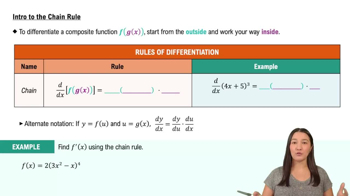
To find the derivative of the composition of functions ƒ(g(x)) at x = 0, we use the chain rule. The chain rule states that the derivative of a composition of functions is the derivative of the outer function evaluated at the inner function times the derivative of the inner function.
The chain rule formula for the derivative of ƒ(g(x)) is: (ƒ(g(x)))' = ƒ'(g(x)) * g'(x).
First, evaluate g(x) at x = 0. From the given data, g(0) = 1.
Next, find ƒ'(g(x)) at x = 0. Since g(0) = 1, we need ƒ'(1). From the table, ƒ'(1) = 1/2.
Finally, find g'(x) at x = 0. From the table, g'(0) = 1/2. Now, apply the chain rule: (ƒ(g(x)))' at x = 0 is ƒ'(1) * g'(0) = (1/2) * (1/2).

Verified video answer for a similar problem:

This video solution was recommended by our tutors as helpful for the problem above.
Video duration:
3m
Was this helpful?

Key Concepts

Here are the essential concepts you must grasp in order to answer the question correctly.

Chain Rule

The Chain Rule is a fundamental theorem in calculus used to differentiate composite functions. It states that if you have a function ƒ(g(x)), the derivative can be found by multiplying the derivative of the outer function ƒ with the derivative of the inner function g. This rule is essential for solving problems involving nested functions, as it allows for the systematic calculation of derivatives.
Recommended video:
05:02
Intro to the Chain Rule

Function Values and Derivatives

Understanding function values and their derivatives at specific points is crucial for applying calculus concepts. In this context, we need to evaluate ƒ(g(0)) and then find the derivative of that composition. The values of ƒ and g at x = 0, along with their derivatives, provide the necessary information to compute the derivative of the composite function using the Chain Rule.
Recommended video:
06:37
Average Value of a Function

Evaluating Derivatives at Specific Points

Evaluating derivatives at specific points involves substituting the given x-value into the derivative expression. In this case, after applying the Chain Rule, we will need to evaluate the resulting expression at x = 0. This step is critical for obtaining the final numerical result, as it translates the abstract derivative into a concrete value that reflects the behavior of the function at that point.
Recommended video:
04:50
Critical Points
Related Practice
Textbook Question

Analyzing Motion Using Graphs


[Technology Exercise] Exercises 31–34 give the position function s = f(t) of an object moving along the s-axis as a function of time t. Graph f together with the velocity function v(t) = ds/dt = f'(t) and the acceleration function a(t) = d²s/dt² = f''(t). Comment on the object’s behavior in relation to the signs and values of v and a. Include in your commentary such topics as the following:


d. When does it speed up and slow down?


s = t³ - 6t² + 7t, 0 ≤ t ≤ 4

Textbook Question

Theory and Examples


In Exercises 51–54,


d. Over what intervals of x-values, if any, does the function y = f(x) increase as x increases? Decrease as x increases? How is this related to what you found in part (c)? (We will say more about this relationship in Section 4.3.)


y = −1/x

Textbook Question

Right circular cylinder The total surface area S of a right circular cylinder is related to the base radius r and height h by the equation S = 2πr² + 2πrh.


d. How is dr/dt related to dh/dt if S is constant?

Textbook Question

Theory and Examples


In Exercises 51–54,


d. Over what intervals of x-values, if any, does the function y = f(x) increase as x increases? Decrease as x increases? How is this related to what you found in part (c)? (We will say more about this relationship in Section 4.3.)


y = x³/3

Textbook Question

Average single-family home prices P (in thousands of dollars) in Sacramento, California, are shown in the accompanying figure from the beginning of 2006 through the end of 2015.


d. During what year did home prices drop most rapidly and what is an estimate of this rate?

Textbook Question

Lunar projectile motion A rock thrown vertically upward from the surface of the moon at a velocity of 24 m/sec (about 86 km/h) reaches a height of s = 24t − 0.8t² m in t sec.

e. How long is the rock aloft?