
Ch. 3 - Derivatives
Hass - Thomas' Calculus 15th Edition
Hass15th EditionThomas' CalculusISBN: 9780137616077Not the one you use?Change textbook
Chapter 3, Problem 3.2.36d

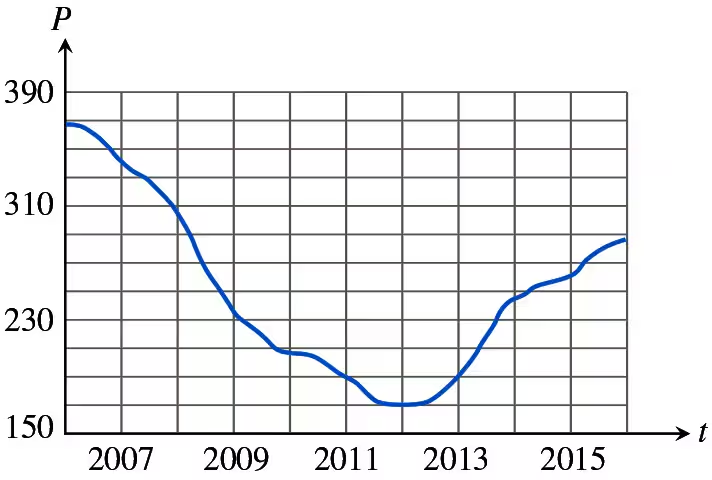
Average single-family home prices P (in thousands of dollars) in Sacramento, California, are shown in the accompanying figure from the beginning of 2006 through the end of 2015.


Graph showing average home prices in Sacramento from 2006 to 2015, with a notable decline around 2008.


d. During what year did home prices drop most rapidly and what is an estimate of this rate?

Verified step by step guidance
1
To determine when home prices dropped most rapidly, we need to find the steepest negative slope on the graph. This corresponds to the largest negative derivative of the price function P(t) with respect to time t.
Observe the graph and identify the section where the curve descends most sharply. This is typically where the graph is the steepest in the downward direction.
Estimate the time period by looking at the x-axis (years) and noting the interval where the steepest decline occurs. In this graph, it appears to be between 2007 and 2009.
To estimate the rate of change, calculate the slope of the tangent line to the curve at the point of steepest descent. This can be done by selecting two points on the curve within the steepest section and using the formula for the slope: (change in P) / (change in t).
Choose two points on the graph within the steepest section, for example, (2007, 390) and (2009, 230). Calculate the slope using these points: slope = (230 - 390) / (2009 - 2007). This will give an estimate of the rate at which home prices dropped during that period.

Verified video answer for a similar problem:

This video solution was recommended by our tutors as helpful for the problem above.
Video duration:
5m
Was this helpful?

Key Concepts

Here are the essential concepts you must grasp in order to answer the question correctly.

Rate of Change

The rate of change measures how a quantity changes over time. In calculus, it is often represented as the derivative of a function, indicating the slope of the tangent line at any point on a curve. For the home prices in Sacramento, the rate of change will help identify how quickly prices are increasing or decreasing during specific periods.
Recommended video:
04:16
Intro To Related Rates

Local Maximum and Minimum

A local maximum is a point where a function reaches a peak within a certain interval, while a local minimum is where it reaches a trough. In the context of the home prices graph, identifying these points can help determine when prices were at their highest and lowest, which is crucial for understanding the overall trend and the year when prices dropped most rapidly.
Recommended video:
06:02
The Second Derivative Test: Finding Local Extrema

Secant Line

A secant line intersects a curve at two or more points and is used to calculate the average rate of change between those points. In this scenario, drawing a secant line between two years on the graph of home prices will provide an estimate of the average rate at which prices dropped during that period, aiding in the analysis of the most rapid decline.
Recommended video:
05:13
Slopes of Tangent Lines
Related Practice
Textbook Question

Analyzing Motion Using Graphs


[Technology Exercise] Exercises 31–34 give the position function s = f(t) of an object moving along the s-axis as a function of time t. Graph f together with the velocity function v(t) = ds/dt = f'(t) and the acceleration function a(t) = d²s/dt² = f''(t). Comment on the object’s behavior in relation to the signs and values of v and a. Include in your commentary such topics as the following:


e. When is it moving fastest (highest speed)? Slowest?


s = 4 - 7t + 6t² - t³, 0 ≤ t ≤ 4

Textbook Question

Suppose that functions ƒ(x) and g(x) and their first derivatives have the following values at x = 0 and x = 1.


x ƒ(x) g(x) ƒ'(x) g'(x)

0 1 1 -3 1/2

1 3 5 1/2 -4


Find the first derivatives of the following combinations at the given value of x.


d. ƒ(g(x)), x = 0

Textbook Question

Analyzing Motion Using Graphs


[Technology Exercise] Exercises 31–34 give the position function s = f(t) of an object moving along the s-axis as a function of time t. Graph f together with the velocity function v(t) = ds/dt = f'(t) and the acceleration function a(t) = d²s/dt² = f''(t). Comment on the object’s behavior in relation to the signs and values of v and a. Include in your commentary such topics as the following:


d. When does it speed up and slow down?


s = t³ - 6t² + 7t, 0 ≤ t ≤ 4

Textbook Question

Right circular cylinder The total surface area S of a right circular cylinder is related to the base radius r and height h by the equation S = 2πr² + 2πrh.


d. How is dr/dt related to dh/dt if S is constant?

Textbook Question

Theory and Examples


In Exercises 51–54,


d. Over what intervals of x-values, if any, does the function y = f(x) increase as x increases? Decrease as x increases? How is this related to what you found in part (c)? (We will say more about this relationship in Section 4.3.)


y = x³/3

Textbook Question

Lunar projectile motion A rock thrown vertically upward from the surface of the moon at a velocity of 24 m/sec (about 86 km/h) reaches a height of s = 24t − 0.8t² m in t sec.

e. How long is the rock aloft?