
A balloon and a bicycle A balloon is rising vertically above a level, straight road at a constant rate of 1 ft/sec. Just when the balloon is 65 ft above the ground, a bicycle moving at a constant rate of 17 ft/sec passes under it. How fast is the distance s(t) between the bicycle and the balloon increasing 3 sec later?
Ch. 3 - Derivatives
Chapter 3, Problem 3.2.37
One-Sided Derivatives
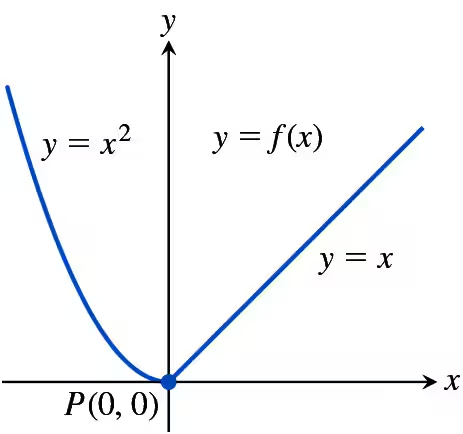
Compute the right-hand and left-hand derivatives as limits to show that the functions in Exercises 37–40 are not differentiable at the point P.

Verified step by step guidance1
Identify the piecewise function f(x) based on the graph: f(x) = x^2 for x < 0 and f(x) = x for x ≥ 0.
To find the left-hand derivative at P(0,0), compute the limit as x approaches 0 from the left: lim (x -> 0-) [f(x) - f(0)] / (x - 0). Since f(x) = x^2 for x < 0, this becomes lim (x -> 0-) [x^2 - 0] / x.
Simplify the left-hand limit expression: lim (x -> 0-) x^2 / x = lim (x -> 0-) x.
To find the right-hand derivative at P(0,0), compute the limit as x approaches 0 from the right: lim (x -> 0+) [f(x) - f(0)] / (x - 0). Since f(x) = x for x ≥ 0, this becomes lim (x -> 0+) [x - 0] / x.
Simplify the right-hand limit expression: lim (x -> 0+) x / x = lim (x -> 0+) 1.

Verified video answer for a similar problem:
This video solution was recommended by our tutors as helpful for the problem above.
Video duration:
2mWas this helpful?
Key Concepts
Here are the essential concepts you must grasp in order to answer the question correctly.
One-Sided Derivatives
One-sided derivatives are limits that assess the behavior of a function as it approaches a specific point from one side only. The right-hand derivative considers the limit as the input approaches the point from the right, while the left-hand derivative considers the limit from the left. If these two limits exist but are not equal, the function is not differentiable at that point.
Recommended video:
One-Sided Limits
Differentiability
A function is differentiable at a point if it has a defined derivative at that point, which means the function must be continuous and have a consistent slope from both sides. If the left-hand and right-hand derivatives at a point are not equal, the function is not differentiable there. This concept is crucial for understanding the smoothness and behavior of functions at specific points.
Recommended video:
Finding Differentials
Limits
Limits are fundamental in calculus, representing the value that a function approaches as the input approaches a certain point. They are essential for defining derivatives, as the derivative itself is the limit of the average rate of change of the function as the interval approaches zero. Understanding limits allows for the analysis of function behavior near points of interest, particularly in determining continuity and differentiability.
Recommended video:
One-Sided Limits
Related Practice
Textbook Question
Textbook Question
Find the derivatives of the functions in Exercises 1–42.
_____
𝔂 = / x² + x
√ x²
1
views
Textbook Question
Derivative Calculations
In Exercises 1–12, find the first and second derivatives.
y = 6x² − 10x − 5x⁻²
Textbook Question
In Exercises 19–22, find the slope of the curve at the point indicated.
y = (x − 1) / (x + 1), x = 0
1
views
Textbook Question
Estimating height of a building A surveyor, standing 30 ft from the base of a building, measures the angle of elevation to the top of the building to be 75°. How accurately must the angle be measured for the percentage error in estimating the height of the building to be less than 4%?
Textbook Question
Second Derivatives
In Exercises 19–26, use implicit differentiation to find dy/dx and then d²y/dx². Write the solutions in terms of x and y only.
y² – 2x = 1 – 2y
