Ch. 3 - Derivatives
Hass - Thomas' Calculus 15th Edition
Hass15th EditionThomas' CalculusISBN: 9780137616077Not the one you use?Change textbook
Chapter 3, Problem 3.9.44

Estimating height of a building A surveyor, standing 30 ft from the base of a building, measures the angle of elevation to the top of the building to be 75°. How accurately must the angle be measured for the percentage error in estimating the height of the building to be less than 4%?

Verified step by step guidance
1
First, understand the relationship between the angle of elevation, the distance from the building, and the height of the building. This can be modeled using the tangent function: \( \tan(\theta) = \frac{h}{d} \), where \( h \) is the height of the building, \( d \) is the distance from the building (30 ft), and \( \theta \) is the angle of elevation (75°).
To find the height \( h \), rearrange the equation: \( h = d \cdot \tan(\theta) \). Substitute \( d = 30 \) ft and \( \theta = 75° \) into the equation to express \( h \) in terms of \( \theta \).
Next, consider the percentage error in the height estimation. The percentage error in \( h \) is given by \( \frac{\Delta h}{h} \times 100\% \), where \( \Delta h \) is the change in height due to a small change in \( \theta \).
Use the derivative of the tangent function to find \( \Delta h \). The derivative \( \frac{dh}{d\theta} = d \cdot \sec^2(\theta) \) gives the rate of change of height with respect to the angle. Calculate \( \Delta h = \frac{dh}{d\theta} \cdot \Delta \theta \).
Set up the inequality \( \frac{\Delta h}{h} \times 100\% < 4\% \) to find the maximum allowable \( \Delta \theta \). Solve this inequality to determine how accurately the angle must be measured to ensure the percentage error is less than 4%.

Verified video answer for a similar problem:

This video solution was recommended by our tutors as helpful for the problem above.
Video duration:
5m
Was this helpful?

Key Concepts

Here are the essential concepts you must grasp in order to answer the question correctly.

Trigonometric Functions

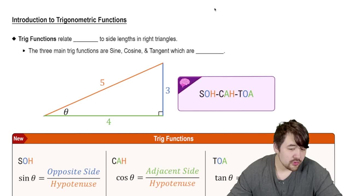
Trigonometric functions, such as sine, cosine, and tangent, relate the angles of a triangle to the lengths of its sides. In this problem, the tangent function is used because it relates the angle of elevation to the opposite side (height of the building) and the adjacent side (distance from the building). Understanding how to apply these functions is crucial for solving problems involving right triangles.
Recommended video:
6:04
Introduction to Trigonometric Functions

Angle of Elevation

The angle of elevation is the angle formed by the horizontal line of sight and the line of sight up to an object. In this context, it is the angle between the surveyor's line of sight and the top of the building. Accurately measuring this angle is essential because it directly affects the calculation of the building's height using trigonometric functions.
Recommended video:
8:22
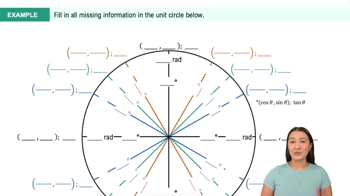
Trig Values in Quadrants II, III, & IV Example 2

Error Propagation

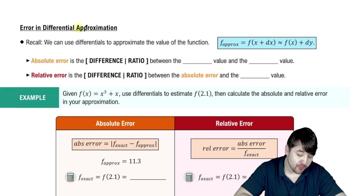
Error propagation refers to how uncertainties in measurements affect the final result. In this problem, it involves understanding how a small error in measuring the angle of elevation can lead to a larger error in the calculated height of the building. Calculating the percentage error helps determine the precision needed in the angle measurement to ensure the height estimate remains within acceptable limits.
Recommended video:
04:57
Determining Error and Relative Error