
Ch. 3 - Derivatives
Hass - Thomas' Calculus 15th Edition
Hass15th EditionThomas' CalculusISBN: 9780137616077Not the one you use?Change textbook
Chapter 3, Problem 3.6.72

Finding Derivative Values


In Exercises 67–72, find the value of (f ∘ g)' at the given value of x.


f(u) = ((u − 1) / (u + 1))², u = g(x) = (1 / x²) − 1, x = −1

Verified step by step guidance
1
First, understand that you need to find the derivative of the composite function (f ∘ g)(x), which means you need to apply the chain rule. The chain rule states that (f ∘ g)'(x) = f'(g(x)) * g'(x).
Calculate g(x) at x = -1. Substitute x = -1 into g(x) = (1 / x²) - 1 to find g(-1).
Next, find g'(x). Differentiate g(x) = (1 / x²) - 1 with respect to x. Use the power rule and the derivative of a constant.
Now, find f'(u). First, differentiate f(u) = ((u - 1) / (u + 1))² with respect to u. Use the chain rule and the quotient rule to differentiate this expression.
Finally, substitute g(-1) into f'(u) to find f'(g(-1)), and multiply this by g'(-1) to find (f ∘ g)'(-1).

Verified video answer for a similar problem:

This video solution was recommended by our tutors as helpful for the problem above.
Video duration:
8m
Was this helpful?

Key Concepts

Here are the essential concepts you must grasp in order to answer the question correctly.

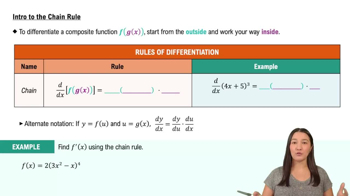
Chain Rule

The chain rule is a fundamental technique in calculus used to differentiate composite functions. If you have a function h(x) = f(g(x)), the derivative h'(x) is found by multiplying the derivative of the outer function f at g(x) by the derivative of the inner function g at x. This rule is essential for finding derivatives of nested functions like f ∘ g.
Recommended video:
05:02
Intro to the Chain Rule

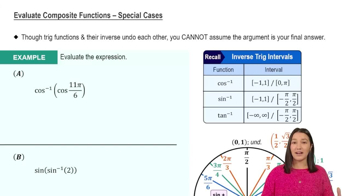
Composite Functions

Composite functions involve applying one function to the results of another, denoted as (f ∘ g)(x) = f(g(x)). Understanding how to work with composite functions is crucial for applying the chain rule effectively, as it requires recognizing the inner and outer functions and their respective derivatives.
Recommended video:
3:48
Evaluate Composite Functions - Special Cases

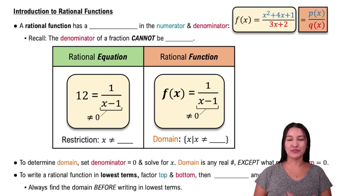
Derivative of Rational Functions

Rational functions are quotients of polynomials, and their derivatives can be found using the quotient rule. For a function f(u) = (u - 1)/(u + 1), the derivative involves differentiating the numerator and denominator separately and applying the quotient rule: (v'u - uv')/v², where u and v are the numerator and denominator, respectively.
Recommended video:
6:04
Intro to Rational Functions