The eight curve Find the slopes of the curve y⁴ = y² – x² at the two points shown here.

Ch. 3 - Derivatives
Chapter 3, Problem 3.9.40
Differential Estimates of Change
In Exercises 35–40, write a differential formula that estimates the given change in volume or surface area.
The change in the lateral surface area S = 2πrh of a right circular cylinder when the height changes from h₀ to h₀ + dh and the radius does not change
Verified step by step guidance1
Identify the formula for the lateral surface area of a right circular cylinder, which is given by \( S = 2\pi rh \), where \( r \) is the radius and \( h \) is the height.
Recognize that the problem asks for the change in the lateral surface area when the height changes from \( h_0 \) to \( h_0 + dh \), while the radius \( r \) remains constant.
To estimate the change in the lateral surface area, use the concept of differentials. The differential \( dS \) represents the approximate change in \( S \) and is given by the derivative of \( S \) with respect to \( h \), multiplied by \( dh \).
Calculate the derivative of \( S \) with respect to \( h \): \( \frac{dS}{dh} = 2\pi r \). This derivative represents the rate of change of the surface area with respect to the height.
Express the differential formula for the change in surface area: \( dS = 2\pi r \cdot dh \). This formula estimates the change in the lateral surface area when the height changes by a small amount \( dh \).

Verified video answer for a similar problem:
This video solution was recommended by our tutors as helpful for the problem above.
Video duration:
1mKey Concepts
Here are the essential concepts you must grasp in order to answer the question correctly.
Differential Calculus
Differential calculus focuses on the concept of the derivative, which represents the rate of change of a function with respect to a variable. In this context, it helps estimate how a small change in one variable (like height) affects another quantity (like surface area). Understanding differentials is crucial for approximating changes in geometric properties.
Recommended video:
Guided course
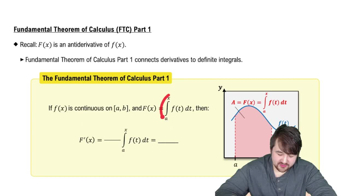
Fundamental Theorem of Calculus Part 1
Lateral Surface Area of a Cylinder
The lateral surface area of a right circular cylinder is given by the formula S = 2πrh, where r is the radius and h is the height. This formula calculates the area of the curved surface of the cylinder, excluding the top and bottom bases. Knowing this formula is essential for determining how changes in height affect the surface area.
Recommended video:
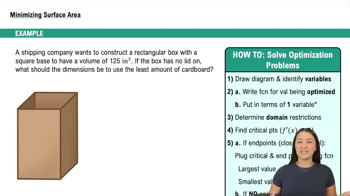
Example 1: Minimizing Surface Area
Partial Derivatives
Partial derivatives are used to find the rate of change of a multivariable function with respect to one variable while keeping others constant. In this problem, the partial derivative of the lateral surface area with respect to height (h) is needed to estimate the change in surface area when the height changes, while the radius remains constant.
Recommended video:
Guided course
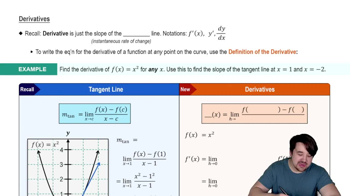
Derivatives
Related Practice
Textbook Question
Textbook Question
Finding Derivative Values
In Exercises 67–72, find the value of (f ∘ g)' at the given value of x.
f(u) = ((u − 1) / (u + 1))², u = g(x) = (1 / x²) − 1, x = −1
1
views
Textbook Question
In Exercises 41–58, find dy/dt.
y = sin²(πt − 2)
Textbook Question
Find the derivatives of the functions in Exercises 1–42.
s = (sec t + tan t)⁵
Textbook Question
Second Derivatives
In Exercises 19–26, use implicit differentiation to find dy/dx and then d²y/dx². Write the solutions in terms of x and y only.
3 + sin y = y – x³
Textbook Question
Free-Fall Applications
Free fall on Mars and Jupiter The equations for free fall at the surfaces of Mars and Jupiter (s in meters, t in seconds) are s = 1.86t² on Mars and s = 11.44t² on Jupiter. How long does it take a rock falling from rest to reach a velocity of 27.8 m/sec (about 100 km/h) on each planet?